Tuesday, November 28, 2006

The Two Cultures continued

While my original post regarding the two cultures of Schizophrenia and Autism was a reference to the Arts and Science cultures of CP Snow, this post is about the cultures in the traditional sense- the American culture pitted against the East Asian culture.


To recap the differences in Autism and Schizophrenia, the difference could be summarized as a linear, literal, realistic, detail-oriented and routine -bound thinking style in Autism and a non-linear(parallel), metaphorical, imaginative, meaning-oriented and novelty preferring thinking style associated with schizophrenia. One of the prime reasons for these differences was hypothesized to be a central coherence tendency in autism (too much focus on foreground and piece-meal perception/ conception) on the one hand and a contextual, broad and loose association tendency in schizophrenia (too much focus on background and a gestalt and holistic sort of perception/ conception) on the other hand.

One can even go a step ahead and characterize the autistic cognitive style as Analytical and the schizophrenic style as Holistic in nature.

That brings us to an interesting hypothesis. It is well known that cultures differ in their cognitive thinking style and it has been demonstrated in a number of studies that the American culture is characterized by an analytical thinking style, while the East Asian cultures are characterized by a holistic cognitive style.

This cross-cultural differences in cognitive style, as popularized by Richard Nisbett'’s book The Geography of Thought, has been found to be displayed in perception ( differences exist in change-blindness based on foreground/background salience and this also correlates with the differential patterns of eye fixations on background/foreground in the two cultures) , in categorization and representations(with either a style based on ecological or habitat-based thinking dominant or a one based on narrow self focus and goal-directed thinking dominant), in thinking (analytic vs holistic thinking), in reasoning about causes ( limited, direct causes vs. a large number of indirect causes) and recently in reasoning about consequences ( with western culture favoring a more direct consequence on an immediately succeeding event and the eastern cultures favoring more indirect consequences on more futuristic events and event effects on the the ultimate outcome).

Various theories have been proposed for these differences including a fear of isolation theory that posits that difference in dialectical vs analytical thinking or the reliance on context for memory recognition is due to the fear of social ostracizing, which causes one to focus more on context; a complex and ambiguous physical environment theory which in a roundabout (and in my view in a flawed) way argues that differences in complexity and ambiguity of towns and city scenes of the two cultures cause the different thinking styles rather than it being the other way round; to this being due to linguistic effects (just like this study which shows that linguistic differences cause changes in spatial cognition, I'm sure there are studies that attribute the different cognitive styles to linguistic effect) or due to genetic differences.

While I will not address the reasons for the differences, I will take as granted the fact that there are reasonable differences in the cognitive style on the figure-ground, details-gestalt and analytical-holistic dimensions and these dimensions are more or less the same sort of cognitive style differences that one sees in schizophrenia and autism.


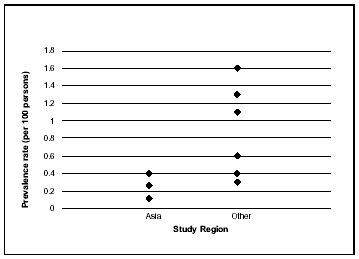
Consistent with this cultural trend, one can predict that in cultures which favor divergent, contextual and holistic thinking , a schizotypal subject would be less susceptible to be labeled as a mentally ill person. These cultures would be more tolerant of this form of thinking and more accommodating of the extreme manifestation. consequently one can hypothesize that in East Asian cultures the incidence and prevalence of Schizophrenia would be way below that in American cultures. This is actually the case with lifetime prevalence in Asian countries being 0.25 as opposed to 0.88 for non-Asian countries.

A reverse trend would be expected in Autism, with American children being diagnosed with autism lesser than the Asian cultures. The results for this prediction are not that optimistic as data on autism prevalence in china is not readily available; but Japanese show an upward trend, while American incidence levels seem to have actually decreased over the years.

Thus, it may actually be the case that autism and schizophrenia signify the Two Cultures.

Before I part, just a parting note on the recently discovered Television and Autism linkage. John Hawks, had commented on the eye movement cultural differences study and in its context had hypothesized that the reason for differences in cognitive style with Americans focusing on the foreground object may be due to the high prevalence in America of cartoon TV viewing which causes one to focus on a one moving object, against a static background.

But let's consider what some of those cultural reasons might be. For example, have American graduate students watched cheaply-animated cartoons for a greater proportion of their lives. You know, the kind of cartoon where the only moving object is the main character, and the background is entirely static for minutes? For that matter, does television viewing in general affect attention.


To me this hypothesis of TV-cartoon viewing and the consequent figure-focus or central coherence seems very promising and might be the reason as to why Autism is rising with increased TV viewings.

Sphere: Related Content

Monday, November 27, 2006

Synapse issue 12 now available

The 12th edition of Synapse is now available at Dr. Deborah Serani's blog.

One of my favorite includes the recent prion-like nucleation-polymerization reaction that has been found in beta Amyloid proteins (whose aggregation results in plaques in Alzheimer's). Although, the polymerization reaction and spread-by-shape mechanism was seen only in those who were genetically susceptible to Alzheimer's and the effect was very specific (thus ruling out infection hypothesis), yet this spread-by-shape may explain some of the prognosis of the illness following the initial trigger.

With some recent new studies indicating that some picornavirus strains my affect memory, an infection triggering hypothesis, followed by malignant spread due to spread-by-shape-mechanism-of-prions in those genetically susceptible may help explain the disease etiology.

Prion mechanism, has been hypothesized as having evolved to prevent cannibalism. Thus, the genes that confer vulnerability to TSE seem to have been fixated in humans; in the case of Alzheimer's the evolutionary rationale may be similar and may have arisen to prevent cannibalism of old family members or even old animals in general. If an infected senile animal, on consumption, confers disease vulnerability on the human who has consumed the meat, then this sort of behavior too may be selected against. As in India (a predominantly vegetarian country), the prevalence of Alzheimer's disease among 70- to 79-year olds is 4.4-fold less than that of the United States, I am tempted to consider the possibility that some of the triggering of Alzheimer's may be due to infected senile-animal food consumption.

Sphere: Related Content

Thursday, November 23, 2006

Schizophrenia and Autism: The Two Cultures.

Mind Hacks has highlighted two posts from the BPS Research Digest that highlight the work of Daniel Nettle, related to Scizotypy and evolutionary benefit especially the linkages between schizotypy and artistic creativity.

To recap the schizotypy dimensions:

  1. Unusual experiences: The disposition to have unusual perceptual and other cognitive experiences, such as hallucinations, magical or superstitious belief and interpretation of events . In the clinical form manifests as positive symptoms of hallucinations and delusions.
  2. Cognitive disorganization: A tendency for thoughts to become derailed, disorganized or tangential. In the clinical form manifests as the positive symptoms of disorganized speech and flight of ideas.
  3. Introverted anhedonia: A tendency to introverted, emotionally flat and asocial behavior, associated with a deficiency in the ability to feel pleasure from social and physical stimulation. This manifests clinically as the negative symptoms of flattened affect,alogia and avolition.
  4. Impulsive nonconformity: The disposition to unstable mood and behavior particularly with regard to rules and social conventions. Manifests clinically as disorganized and socially inappropriate behavior like dressing inappropriately.


To summarize the key findings of the first Nettle paper:

  1. Unusual Experiences dimension (in general population) correlated positively with number of partners and mating success. This relationship was mediated by creative activity. Thus, unusual experiences are hypothesized to lead to creative activities, which in turn increase reproductive fitness.
  2. Impulsive Nonconformity had a direct positive correlation with number of partners and mating success. It independently led to increase in reproductive fitness and the effect was not mediated via creative activity.
  3. Introvertive Anhedonia decreases creative activity, and also has a direct negative effect on mating success.
  4. Cognitive Disorganization seemed to had no significant effect on mating success.
  5. Thus, while part of the reason for continuing prevalence of schizophrenia/schizotypy may be explained by the direct effect of Impulsive Non-conformity on Mating Success, the other part can only be explained by the benefits of creative activity that are conferred by Unusual Experiences.

As Introverted Anhedonia has a negative effect on both creative activity and mating success, it seems reasonable to posit, that while schizophrenia patients may suffer from the negative interaction between Unusual Experiences and Introverted Anhedonia; some of their relatives may benefit from the unusual experiences, while being spared from the effects of Introverted Anhedonia, and thus be specially selected for mating success that is mediated by creative activity. This creative advantage that the relatives of schizophrenia have, may have led to the fixation of this disorder in humans.

The second nettle paper explores the relationship between schizotypy and artistic creativity. the key finding here are:

1. Poetic creativity:
  • Unusual Experiences score increase in a significant manner from non-poets, to hobbyists to serious poets. It slightly decreases with professional poets.
  • The same trend is shown by Impulsive Nonconformity and Cognitive Disorganization.
  • Introverted Anhedonia, on the other hand, shows a non-significant trend to decrease with increasing creative activity.
2. Visual art creativity:
  • The trends for Unusual Experiences, Impulsive Nonconformity and Cognitive Disorganization are the same as in case of poetry, the only difference being that Cognitive Disorganization trend is not significant.
  • Introverted Anhedonia, on the other hand, shows a significant trend to decrease with increasing creative activity.
3. Mathematical creativity:
  • The trends are opposite to that of poetic and visual arts creativity in this case.
  • The scores for Unusual Experiences, Impulsive Nonconformity and Cognitive Disorganization decrease with mathematics engagements level.
  • The scores for Introverted Anhedonia, increase and correlate with mathematical activity.
4. The conclusion is that schizotypal traits like Unusual Experiences, Impulsive Nonconformity and Cognitive Disorganization are instrumental in creative thinking and thus have beneficial effects of stimulating creativity. Though the effect size of Unusual Experiences is the strongest, other traits also have significant effects. Increasingly serious creative engagement is associated with a decrease in introvertive anhedonia and this negative trait is thus a liability.

The authors thus conclude:

The findings provide some support for the two-factor model of Barron (1972). Creative groups are as high as patients on unusual experiences and cognitive disorganization, but lower than controls on introvertive anhedonia. Thus, artistic groups and psychiatric patients share divergent thought, but they differ in that the latter are troubled with negative symptoms such as avolition and anhedonia, whilst the former are unusually free of these traits. This is also congruent with Schuldberg's findings that creativity scores are positively correlated with scales of positive psychotic or hypomanic symptoms, and negatively.


This, the author had hypothesized earlier in the paper, might be an alternative to an inverted-U model of benefits provided by Schizotypal traits.:

An alternative possibility comes from the two-factor approach of Frank Barron. Barron (1972) argued that successful creativity combines deviant and psychopathological traits with high scores on measures of 'Ego strength'. Ego strength includes resilience, ability to cope with stress, self-control and high levels of experienced well-being. Ego strength is thus a mediating factor that determines whether schizotypy is translated into damaging symptoms or healthy creative output. Schuldberg's(1990) work is relevant to this model, finding as it does that scales based on positive symptoms correlate positively with creativity scores, whereas scales based on negative symptoms correlate negatively. Thus, a lack of negative symptoms would appear to be equivalent to high 'Ego strength' in Barron's terms. The prediction in terms of the O-LIFE dimensions would therefore be that creativity would be associated positively with unusual experiences but negatively with introvertive anhedonia.


He further tries to correlate this with the 'systemising' theory of autism:

This profile supports the picture of the mathematical mind as having opposite features to the artistic one, with a narrow range of associations (low unusual experiences), an interest in order (low cognitive disorganization), and in routine (low impulsive nonconformity). These findings are consonant with Baron-Cohen's work on systemising as a core feature of autistic spectrum disorders. Systemising is a cognitive style characterized by a drive for order and regularity, which is elevated in high-functioning autism and in mathematics and engineering (Baron-Cohen et al., 2003; Baron-Cohen et al., 2001). The constellation of autism, systemising and science appears to be in many respects the opposite tail of the distribution to the constellation of arts, unusual experiences and affective and psychotic disorders explored in the present study.


The authors, also present the following theory of autism:

Autistic traits are in many ways the converse of the unusual experiences component of schizotypy. Whereas schizotypal thought is characterized by often metaphorical leaps from domain to domain, remote associations, and broad attentional set, autism is characterized by narrow interests and liberality, with occasionally highly developed abilities in tasks requiring systematic and convergent thinking.


I believe they have stumbled on a very important conceptualization. I myself had been contemplating the Schizophrenia- Autism linkages for quite some time. In my view, the contention that Schizophrenia reflects aspects of artistic creativity, while Autism may reflect aspects of mathematical creativity is a positive diversion form the usual male/female systematizing/empathizing spin on Autism. It is instructive to note, that while Autism is a predominantly male illness, prevalence of Schizophrenia too, is greater in Males compared to females. thus, a simple Male- Female dichotomy does not work.

I do believe that there are theory-of-mind deficits in Autism and these are responsible for their social difficulties, and this may be the opposite of the empathetic brain, but that deficit in empathy should not be construed as equivalent to a positive endowment with systematic thinking. In my view, the empathy defect is independent of the other defects like communicative and repetitive and stereotyped behavior defects. The empathy defect has to do with emotions and feelings, while the other defects might be cognitive and behavioral in nature.

Both Schizophrenia and Autism are spectrum disorders, and hence we will consider differences between the spectrum.

Let me now address the differences in Autism and Schizophrenia spectrum :

  1. Literal vs Metaphorical thinking. One of this blog's reader, Mrs Mc Ewen, had recently left a comment on this site and I discovered that she is a mother of two autistic kids and maintains a blog related to that. I found one of the entries related to Literal interpretation in autism both humorous, informative and sad at the same time. On the other hand, I am well acquainted with the metaphorical thinking indulged in by schizophrenics (I've written a sort of Novella that revolves round that theme), and as I find the Conceptual Metaphor Theory for linguistic semantics full of promise, I have no trouble understanding the language developmental delay in Autism, or the literary/ artistic creativity of Schizotypal pro band. After all, much of art is using symbolism, metaphor etc and involves non-literal interpretation. This difference alone can account for the communication deficits faced by Autistic children. This is related to the schizotypy dimension Unusual Experiences.
  2. Convergent Vs Divergent thinking: Schizophrenia spectrum is marked by cognitive disorganization, flights of ideas and looses associations. It is also marked by including too much of context and in pathological cases characterized by an effort to relate each and every happening to some preexisting context (if the context is of Paronia- every event is a conspiracy; if the context is of grandeur, every event is significant and referring to self). Autistic spectrum, is not only marked by the absence of these and a low score on the corresponding schizotypal trait; but by an opposite tendency of Central Coherence. there is some research that indicates, that Autistic children show both perceptual and conceptual central coherence: i.e. a tendency to only focus on one piece at a time and an inability to use gestalt perception or conceptualization whereby one could indulge in a top-down 'imaginary' assembly of fragments to identify an object. thus, they take , too little of context, in my view and make lesses association than desired. One can also hypothesize, that would yield lesser scores than controls and definitely lesser scores than schizophrenics on the unusual/ novel object uses task. This may also partially explain symptoms like circumscribed and specialized interests in autism. This is related to Schizotypy dimension Disorganized Thinking.
  3. Reality vs. Fantasy (imagination) orientation: This relates to whether one has an ability to indulge in make-believe or in activities like pretend play. I believe that this propensity to use imagination may be linked to the unusual experiences like hallucinations that are found in schizophrenics. Magical thinking, involving endowing inanimate objects like Voodoo dolls or lucky charms, with causative powers may be converse of the autistic inability to differentiate between animals and inanimate objects, or to easily learn to distinguish between self-intended motion of a human/ animal and a pushed or caused motion of an inanimate object. It is instructive to pause here, and reflect, that much of human Agreeableness and Empathy also has to do on make-believe. One may not always love one's friend, but out of respect and social courtesy, one would always pretend to do so. The reality orientation of autistic children, (apart form any empathy/ mirror neuron defects) may also underlie their social difficulties like inability to make friends and impaired social play. This is related to the schizotypy dimension Unusual experience.
  4. Routine and order Vs. Novelty preference: Autistic children are characterized by repetitive and stereotyped behavior. Schizophrenia spectrum on the other hand is high on Openness to Experience and usually display preferences for reckless, novel, socially inappropriate and sensation seeking behavior. This difference may underlie the stereotyped behavior like rigidity exhibited by autistic children. This is related to schizotypy dimension Impulsive, Nonconformity.

Overall, one possible mechanism underlying these differences can be a sensori-motor and conceptual gating defect in both the disorders- with schizophrenia signifying a very broad sensori-motor and conceptual gate with consequent broad attentional span, loose associations and too much of context; and Autism representing a very narrow spatial and temporal gate with consequent specialized interests and focus, few associations, literal and convergent thinking.

If one couples this with the phenomenon of pre-pulse inhibition (defect of schizophrenia) , then it may be theorized that as a schizophrenic would interpret all stimuli in a novel way (presentations of a stimuli earlier, does not lead to its memory or the suppression of the startle response), hence it would also develop preference for, or at least not be intimidated by, a novel item. On the other hand, due to the smaller sensory gate, and normal PPI, the autistic children would mostly be exposed to the smae stimuli over and over gaian and may develop a preference for it over any new stimuli which, when gated through its small gate, would cause it to get startled. I am even tempted to theorize that autistic children may have a high PPI than normals, but a quick Google search didn't corroborate my speculations.

Lastly, a discussion of Anhedonia, and how that interacts with positive schizotypy and autism will need some more thinking and conceptualization. For now, I am tempted to posit that Anhedonia may be one of the dimensions of the female counterpart of Schizotypy-Autism thinking styles. Females, I believe, are more prone to depression (the primary correlate of Anhedonia) and maybe just like a Schizotypy-Autism spectrum that is along cognitive thinking styles; there might exist a Depersonlization-Bipolarity spectrum that runs along the emotion-motivation feeling styles and may reflect the two fundamental styles of emotional processing- one involving use of too much emotion and motivation (bipolarity) and the other characterized by lack of emotion and motivation (depersonalization).

While creativity (thinking) of both types (scizotypal-autistic or artistic-scientific), might have been selected by sexual selection in males; the corresponding traits that would be under sexual selection for females might be virtue/aesthetics (feeling) of both types: one subjective and based on personal constructs of emotions and motivations and the other objective and based on utilitarian concerns and needing one to put aside one's own feelings and emotions.

Just a speculation. Do let me know, your views and opinions (or any supporting researches)!


Sphere: Related Content

Wednesday, November 22, 2006

Five Minds, The Big Five and the Five Faces of the Genius

Howard Gardner, is currently promoting his new book, Five Minds for the Future, and more information about the same is available here.

The five minds—disciplined, synthesizing, creating, respectful, and ethical—differ from multiple intelligence in working in a more synergistic fashion as opposed to separate categories of intelligences.

The “disciplined mind,” Gardner argues, is not simply knowing a particular subject but “learning to think the way people who are experts in the field think,” and should develop by the end of secondary school.

The second type of mind, the “synthesizing mind,” is defined by “deciding what to focus on, what’s important, what to ignore, and putting that together in a way that makes sense.” With a dearth of information about synthesizing in textbooks, Gardner has become most intrigued by this concept. Gardner considers himself primarily a synthesizer, but now as a “fish that has suddenly discovered he’s in water,” Gardner is faced with the challenge of uncovering what goes on as people synthesize, what is good versus bad synthesis, and how to enhance the process.

Discussing the creative mind, Gardner points out that today “creating is a premium and not an option.” While one needs a certain amount of discipline and synthesizing to create, too much of either will stifle creativity.

To foster creativity in the classroom, Gardner recommends that teachers “model novel approaches and answers to questions and indicate [to students] that those responses are legitimate.” Students should be encouraged to come up with innovative approaches, discussing ideas that did not work and alternative models. There should also be study of “examples of creative ideas, actions, behaviors,” figuring out how success was attained, and what obstacles had to be overcome.

While the first three minds are more cognitively oriented, the last two, respect and ethics, have more to do with personality and emotion. The respectful mind, Gardner indicated, has to do with “how we think and relate to other people, most importantly to other people around us.”

While this mind develops at a relatively young age, a kind of intuitive altruistic sense of reaching out to those around us, “attempting to understand differences and work with them,” the ethical mind is more abstract, and generally develops during adolescence. It has to do with fulfilling one’s responsibility in the world in terms of job role and as citizen, thinking in terms such as: “I’m a teacher…journalist…physicist, carrying out that role in the most professional way I can.”

Although, Gardner thinks that only the last two types of mind are related to personality and emotion, I believe that the first three types of 'cognitive' minds can also be related to personality types, as it is my contention that personality dimensions are just different styles of cognition and emotion.

I would thus like to draw attention to the parallels here, with the big five personality traits or the factors of the Five-factor model (OCEAN)

The disciplined mind utilizes the Conscientiousness traits of self-discipline, carefulness, thoroughness, orderedness, and deliberation to develop the thinking style marked by mastering the conventional way in which the experts familiar with the domain usually think.

The synthesizing mind, utilizes the Neuroticism traits that basically refer to an ability or inability to deal with environmental stimuli in a meaningful way. While discussions of neuroticism are usually couched in emotional terms-more reactive sympathetic nervous system, and more sensitivity to environmental stimulation - I also belive that there is a cognitive dimension here, that pertains to whether one reacts to all and every stimulus (information) or is more 'cognitively calm and composed' and uses deliberation in sorting the relevant information from irrelevant one rather than reacting to every little information nugget. This precisely is the synthesizing mind - able to focus on what is important and the ability to not get burdened by information overload. This is the emotional equivalent of not getting overwhelmed by environmental stress.

The creative mind, I believe, utilizes the Openness to Experience traits like unconventional and individualistic beliefs,broad interests, novelty preference and imagination to indulge in a thinking style that is marked with creativity- the ability to create something novel.

The respectful mind, utilizes the Agreeableness traits of consideration, friendliness, generosity, helpfulness and concern with cooperation and social harmony to indulge in a thinking style that is imbibed with an altruistic sense of reaching out to those around us, “attempting to understand differences and work with them."

The ethical mind, on the other hand, utilizes the Extraversion traits of enjoying human interactions, enthusiasm, talkativeness, assertiveness, gregariousness and pleasure in social interactions to indulge in a thinking style marked with emphasis on activity and social role and responsibility - the precise recipe for the ethical mind!

Gardner also proposes a relationship/ hierarchy between the five minds.

In the latter part of his book, Gardner explores the interaction between five minds. He doesn’t see them as isolated categories, but as a general taxonomy followed by respect before ethics, discipline before synthesis, ultimately creating.

This implication of a developmental framework, in which the order of development is - discipline, synthesis, respect, ethics and creativity - maps very well to my own obsession with a five stage developmental model of cognitive, moral, perspective-taking, linguistic , symbolic, pretend-play and other abilities. I believe that Gardner has got the order wrong, and the traits (and the Five minds) develop in the following order- Neuroticism, conscientiousness, Extraversion, agreeableness and finally Openness to Experience. I may be wrong here, but I would write in detail on my rationale for this developmental path in a subsequent post.

While it is reasonable to stop here, I am tempted to take the analogies further and link this up with the Five Faces of the Genius.

To me, the Fool epitomizes perseverance and thus a Disciplined and Conscientious mind.

The Observer epitomizes ability to pick a needle from a haystack and thus a Synthesising and a low Neurotic (cognitively stable) mind.

The Alchemist, with its focus on active bridging and connection between domains, seems to reflect an ethical and extraverted mind.

The Seer, with an ability to imagine and visualize, may have a corresponding capacity to imagine and feel other;s emotions and this empathy leading it to have a respectful and Agreeable mind.

The Sage, with its ability to simplify, may find a resonance in the openness traits of 'preferring the plain, straightforward, and obvious over the complex, ambiguous, and subtle' and may be linked to the creative and Open mind!

Do let me know, how you find these conjectures and linkages. I hope I am not using the analogical reasoning of the alchemist to an unacceptable extreme!! Even if I am, you can be sure that it is just due to my high energy levels and my ethical concerns!!

Sphere: Related Content

Monday, November 20, 2006

Encephalon 11: for Prime Time Viewing only!!


Hi,

I am Sandeep Gautam, your host for tonight, and it is my pleasure to walk you through this brand new episode of the brain carnival called Encephalon.

Before I start, my co-host for tonight, Caroline from the SharpBrains blog, would like to request you to turn off the music, unplug your headphones and concentrate solely on the stories presented in this carnival, to the exclusion of everything else. She recently found that we have limited attentional capacities and that is the reason why we turn down the radio, when we are lost and trying hard to find the correct route. Its common knowledge, that browsing through a collection of cutting edge science posts, from around the world, can be quite taxing on your attentional capacities and there is no room for divided attention here. For those addicted to music, she has some advice to offer - do a simple multitasking task at first and practice before moving on to this more complex task. So all you music addicts are advised to read the mouse trap archives (which evidently don't require much processing or brain use at all) and practice on that easier task first!!

Let me now start with a short recap (Did you every watch a show that didn't have a 'short' recap?). Last time the Mouse Trap hosted a carnival (Synapse #6), we took the readers on a historical journey , where staff correspondent The Neurophilosopher, recounted the story of how Neurons were discovered. That show went on to create history (it is one of the most viewed and popular story on the Neurophiliosopher's blog). This week the Neurophilosopher continues his historical voyage and explores how the nerve function and structure were discovered. While the initial enchantment with the 'animal spirits'/ 'humour' theory led to the emergence of related concepts like the Sanguine, Choleric,Phlegmatic and Melancholic temperaments; the latter day intoxication of Descartes with spirits, was instrumental in the emergence of the hydraulic metaphor for brain/ nerves/ emotions. The conceptualization of nerves, starting from 'hollow tubes', to that of conductors of 'animal electricity', to the modern notions of synaptic chemical transmission and voltage gate function of ion channels has involved the joint effort of many outstanding luminaries, endowing Noble prizes, on three pairs of scientists, along the way. It is also heartening to note, that Andrew Vesalius, in his 'On the Fabric of the Human Body', was not haunted by the animal spirits and was able to take a more rational stand. That may explain why he is one of the authors making it to the shortlist of 25 best science books ever.
(This edition of Encephalon is going very good by far: I have already managed to plug in references to some of my own posts!!)

We all love a good debate , don't we? While it has become increasingly unnecessary to defend evolution against the tirade of Intelligent Designers/ Creationists, yet someone has to take the cudgels, every now and then, and expose the IDers for what they are . In the Debunking section, PZ Myers, of the Pharyngula, responds to the continuing fascination of IDers with the Eye as a designed object, and drives home the point that the presence of shared, deep elements in the diverse and different types of eyes found in the natural world, is reflective of a common descent. He starts off with an article on A Panda's thumb, that argues that the backward layout of vertebrate eye (with nerves and blood vessels placed before the photorecpetors and in the path of incoming light) is a bad design and a quirk of evolutionary history and does not confer any said advantages like the 'cooling of retina'. While PZ Myers, concedes the possibility that an imperfect design and multiple types of eyes, can still be explained by IDers as the result of an Incompetent Designer (on the other hand one can argue that the fact that there are so many different kinds of eyes, each suited to the organism that has it, is proof of a watchmaker, that designs different watches for different needs- a sports watch for trendy youths, a classical gold -plated watch for aged people, and a gizmo-heavy watch for the geek) , he shows that the shared elements (opsins) in the rhobodermic (invertebrate) and cilliary (vertebrate) eyes point towards a common historical descent and are part of the same phylogenetic tree. This makes evolution as the prime candidate for explanation of eye features as they exist. Interesting to note, that c-opsins are also present in the invertebrates and used in Circadian rhythms, while r-opsins are also found in vertebrates and are implicated in circadian rhythm resetting. Well, IDers can still use this as an ammunition for their theories: claiming that the r-opsins in humans is the mythological Shiva's Third Eye. One can play the devil's advocate (I like this part and would gladly do the honors) and claim that two types of eye systems -one r-based, the other c-based are also logical outcomes of physical facts- just like two systems of watches exists - analog and digital - so also do the physical facts of perception decree that 2 types of eyes can be possible - one r-based and the other c-based - and their presence in vertebrates and invertebrates does not point to common descent, but only spurious relationships. I'll let PZee thrash these arguments in his next posting.

Meanwhile, we keep pipping Mythbusters to the post, with vigilant reporters not only debunking the old and haunting myths (like that of a non-blind watchmaker), but also actively nipping in the bud, new myths as they are being formulated and proposed. One such myth is that of exaggerated differences in Male and Female brains and abilities, and Jake Young from Pure Pedantry has covered this earlier too. This time, he returns to examine the extreme, 'male brain', systematizing theory of Autism, and concludes that if extreme male interests/abilities are indeed a symptom of autism, then in the light of the fact that male-female differences are largely socio-cultural, while autism is largely genetic, one can only conclude that the differences in systematizing are an epiphenomena, and not a cause. Moreover, the theory of assortative mating that Simon Baron-cohen proposes , as well as his emphasis on systematizing, to the exclusion of the other major symptoms of autism like social and communicative difficulties, appear lacking and non-comprehensive. Repetitive behavior can be adequately explained by systematising, but how can something as elementary as eye contact aversion follow from geekiness or nerdness of the autistic boy and be a consequence rather than a cause?

While the theory of Autism may be quite controversial and how to help children with Autism not clear, yet for the normal , anxiety and stress- driven, school-going child, we have some hope. They can now cope with the stresses, increase focus and manage emotions, all by themselves. Alvaro, from the SharpBrains blog, reports on an exciting biofeedback program that has managed to improve the performance of children appreciably by providing them feedback about their own stress levels -measured as heart rate variability- and encouraging them to use meditation techniques like Yoga to calm down in stressful situations.

Ok folks, Its time to take a break! See you after the commercials! (All good programs do have commerical breaks!)

But in this commercial break, you will not be flooded with Advertisements that purport to increase your ------ to double its size. (Hey guys, what are you thinking, that ----- was to be filled with a brain muscle name. I can assure you the reference was in no way related to 'what the normal male thinks about every 2 minutes'!)

Instead, in this break, Joe Kissel , of the Interesting Thing Of The Day blog, would like you all to take a Power Nap. No need to watch the commercials. Just take a short power nap- and return rejuvenated - with improved memory, attention and cognitive performance. If sleeping is not your cup of tea, resort to Power Blogging (do remember to quote me if you use this term, I invented it just now!) instead. Fernette and Brock Eide at the Eide Neurolearning blog, report on how blogging increases various cognitive abilities like critical, associational and analogical thinking. But just like the Power Nap, keep your Power Blog posting of a reasonable length. While a long nap would leave you groggy and unable to work, a long post may not have the same effect on you, but would definitely end up making your readers groggy and distracted. believe me, I know from personal experience!

Ok, Welcome back! After the break, we take you out from our studio, and into the fields, where actual stuff happens. Our special correspondent, Chris Patil, of Ouroboros blog, was covering the annual scientific meeting of the Larry L Hillblom Foundation, and reports straight form the filed on the strategy of passive immunization for Alzheimer's. The procedure involves giving the antibodies, that target amyloid Abeta oligomeres, directly to the patients. Interestingly, these antibodies also target IAPP, thought to be instrumental in type II diabetes and may offer some help in curing that disease too. As the prevalence of Diabetes in India is quite high (and as I have a family history of this disease), I'll surely be following the developments here.

Its show time folks! Michael, from the Peripersonal space, presents a retrospective of Charles and Ray Eames film and multimedia work. The makers of such films like the Powers of Ten they are also famous for the creation of the Eames chair and frequently employed and incorporated the latest cognitive psychology concepts in their films and presentations. For example, in their Rough sketch for a sample lesson of a hypothetical course, they not only made efficient use of visuals and sounds (loud enough to make you feel vibrations), but also incorporated smells piped through the ventilation system. The effects were striking, with people smelling oil when seeing it, when no odor was actually present, but because they expected a smell just like they had received for the other scenes.

Odor is strongly linked with memory, and as Vaughan from the Mind Hacks blog, had highlighted, the retronasal olfactory system is also strongly linked with Flavor or Taste Perception. So, with the correct use of technology, (flavor odors presented when people gasp after seeing a visual and are exhaling air and are thus using retro nasal system), one can even induce the sense of taste. When sight, sound,smell, touch (vibrations due to loud sounds) and flavors are combined in a presentation, I am sure the results would be terrific.

Michael, specializes in peripersoanl space and the associated proprioception sense, so I am sure we can even include proprioceptive, vestibular and kinesthetic effects in the future presentations! Meanwhile, Michael continues on his exploration of psychological themes and concepts in Charles and Ray Eames work, and proposes that the reason they used seven simultaneous screens in Glimpses Of USA, may have been partly due to the known 7+-2 limits of the working memory and how having seven screens would force viewers to sample from all of them without being overwhelmed.

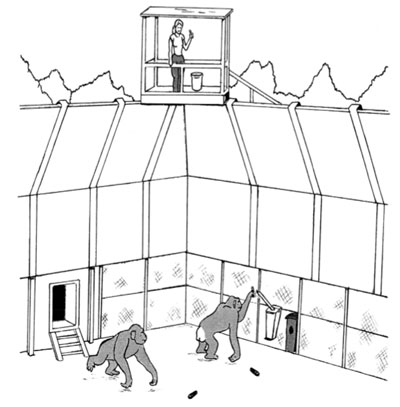
While we are talking about show business, let us also indulge in some celebrity gossip. Everyone knows that the alpha male in chimpanzees, is equivalent to the human celebrity, but nobody had though that chimps too indulged in celebrity worship. Olivier, from the AplhaPsy blog, reports on how his job as a paparazzi, was finally rewarded, when he came across a striking conclusion - that the other chimps, when they were replicating a social-convention, were not actually learning a convention at all. They were just imitating the celebrity, the alpha male, and that the conclusions derived about a theory of mind or social-convention learning in chimps, based on this experimental setup, are flawed.

In our chat section, Alvaro from the SharpBrains blog, makes some Hard Talk with Dr Brett N Steerbarger, who has written extensively on trading and the psychology that is involved in improving trading behavior. They discuss how concepts of structured learning, continuous feedback, self motivation and developing an expertise in a niche are relevant in the context of improving trading performance. If you are a short term trader, you need to see patterns quickly and so need to increase your processing speed and working memory. For long term traders, analytical skills are paramount, while everybody can benefit from emotion management. Expert traders, like all experts in their fields, are a result of skills that are practiced, honed and fine-tuned, sometimes under the instructions of a coach. We are sure you would increase your trading capacities immensely if you took this advice seriously and indulged in some trader specific training. Don't forget to share your increased revenues with this humble blog at that time!!

While expertise, as a result of hard work, rather than training, is one of the most debated issues in Intelligence Psychology, another issue that keeps cropping is the nature of intelligence. Is there an underlying 'g' factor, or is the correlation between the IQ test explicable otherwise. Hugo, from the AlphaPsy blog has the second opinion and reports on a new paper that does away with an underlying 'g' and explains the correlation in terms of effects of one ability on the other.

In our last section (I can anticipate your relief!), we look towards the future and anticipate future trends. IB, from the Fibromyalgia Research Blog, reports on a recent study that found abnormal cerebral activation (increased neural recruitment) during cognitive tasks in Fibromyalgia and Chronic Fatigue Syndrome. He suggests that future study be focussed on finding the neurocognitive mechanisms underlying cognitive deficits like abnormally slow brain waves and sleep disturbances that are found in Fibromyalgia.

Before you leave, our sponsors, Dr Kavokin, from the Rdoctor blog, have some exciting gifts for you. Quickly answer a short quiz about low back pain and take home some cool prizes. While you can savor the quiz at your leisure, I would like to highlight question # 4 regarding whether smoking relieves the back pain or exacerbates it. That question has direct significance to us, as it indicates how mental attitudes affect physical illnesses. Rush in your entries or SMS TRUE/ FALSE on our hot line number 0000. You can also e-mail your answers to dump@junk.com. Exciting prizes like laptops, iPods and windows viruses are waiting for you!

Thats all for tonight. We will return in a fortnight's time, with the 12th episode of the Encephalon, same time, same day. Don't forget to tune in. Your hosts for that show would be Hugo, Olivier et al at the AlphaPsy blog . The day is 4th of December.

For now, please allow your host to thank all the behind-the-scenes persons - the actual contributors!! Thanks and good night!!

Sphere: Related Content
Friday, November 17, 2006

Encephalon 11: last call for submissions

The Encephalon #11 would be hosted right here on The Mouse Trap on the 20th of this month. So rush in your submissions as soon as possible. Just two more days left!! Send the best cognitive blog-posts from around the web to encephalon.host@gmail.com.

Looking forward to enthusiastic submissions.

Sphere: Related Content

Vote for your favorite science book ever

The discover magazine has unveiled its collection of 25 best science books ever and has also put up these books for online voting, whereby you can vote for your favorite science book from the 25 shortlisted, or vote for a book of your choice that is not listed.

Interestingly, Darwin's The Origin of Species wins hands down in the online voting; with only Newton and Einstein giving some challenge. Also, as many as ~15 % of voters have voted for books not in the shortlist. More interestingly, Freud has just been able to get an honorable mention!

The accompanying article by Kary Mullis is a nice read.

So what are you waiting for? Go ahead and vote for your favorite amongst such writers as Gould, Wilson and Dawkins (why do they shortlist so many evolutionary thinkers...and on a similar note why do we have so many blog postings on evolution, especially defending/proving evolution?) ..and then there is Oliver Sacks and James Watson too, so plenty of choices for the regular readers of this blog.


Tags:

Sphere: Related Content
Artificial Neural Networks: temporal summation, embedded 'clocks' and operant learning

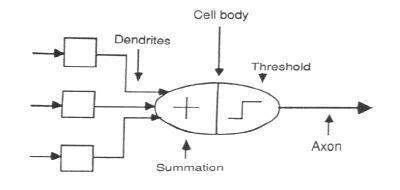
Artificial Neural Networks have historically focussed on modeling the brain as a collection of interconnected neurons. The individual neurons aggregate inputs and either produce an on/off output based on threshold values or produce a more complex output as a linear or sigmoid function of their inputs. The output of one neuron may go to several other neurons.


Not all inputs are equivalent and the inputs to the neuron are weighed according to a weight assigned to that input connection. This mimics the concept of synaptic strength. The weights can be positive (signifying an Excitatory Post-Synaptic Potential ) or negative (signifying an Inhibitory Post-Synaptic Potential).


Learning consists of the determination of correct weights that need to be assigned to solve the problem; i.e. to produce a desired output, given a particular input. This weight adjustment mimics the increase or decrease of synaptic strengths due to learning. Learning may also be established by manipulating the threshold required by the neuron for firing. This mimics the concept of long term potentiation (LTP).


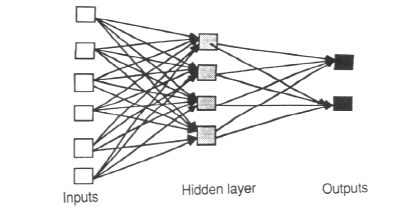
The model generally consists of an input layer (mimicking sensory inputs to the neurons) , a hidden layer (mimicking the association functions of the neurons in the larger part of the brain) and an output layer ( mimicking the motor outputs for the neurons).


This model is a very nice replication of the actual neurons and neuronal computation, but it ignores some of the other relevant features of actual neurons:

1. Neuronal inputs are added together through the processes of both spatial and temporal summation. Spatial summation occurs when several weak signals are converted into a single large one, while temporal summation converts a rapid series of weak pulses from one source into one large signal. The concept of temporal summation is generally ignored. The summation consists exclusively of summation of signals from other neurons at the same time and does not normally include the concept of summation across a time interval.

2. Not all neuronal activity is due to external 'inputs'. Many brain regions show spontaneous activity, in the absence of any external stimulus. This is not generally factored in. We need a model of brain that takes into account the spontaneous 'noise' that is present in the brain, and how an external 'signal' is perceived in this 'noise'. Moreover, we need a model for what purpose does this 'noise' serve?

3. This model mimics the classical conditioning paradigm, whereby learning is conceptualized in terms of input-output relationships or stimulus-response associations. It fails to throw any light on many operant phenomenon and activity, where behavior or response is spontaneously generated and learning consist in the increase\decrease \ extinction of the timing and frequency of that behavior as a result of a history of reinforcement. This type of learning accounts for the majority of behavior in which we are most interested- the behavior that is goal directed and the behavior that is time and context and state-dependent. The fact that a food stimulus, will not always result in a response 'eat', but is mediated by factors like the state (hunger) of the organism, time-of-day etc. is not explainable by the current models.

4. The concept of time, durations and how to tune the motor output as per strict timing requirements has largely been an unexplored area. While episodic learning and memory may be relatively easier to model in the existing ANNs, its my hunch that endowing them with a procedural memory would be well nigh impossible using existing models.


Over a series of posts, I would try to tackle these problems by enhancing the existing neural networks by incorporating some new features into it, that are consistent with our existing knowledge about actual neurons.

First, I propose to have a time-threshold in each neural unit. This time-threshold signifies the duration in which temporal summation is applicable and takes place. All inputs signals, that are received within this time duration, either from repeated firing of the same input neuron or from time-displaced firings of different input neurons, are added together as per the normal input weights and if at any time this reaches above the normal threshold-for-firing, then the neuron fires. This has combined both temporal and spatial summation concepts. With temporal summation, we have an extra parameter- the time duration for which the history of inputs needs to be taken into account.

All neurons will also have a very short-term memory, in the sense that they would be able to remember the strengths of the inputs signals that they have received in the near past , that is in the range of the typical time-thresholds that are set for them. This time-threshold can typically be in milliseconds.

Each time a neuron receives an input, it starts a timer. This timer would run for a very small duration encoded as the time-threshold for that neuron. Till the time this timer is running and has not expired, the input signal is available to the neuron for calculation of total input strength and for deciding whether to fire or not. As soon as the timer expires, the memory of the associated input is erased from the neurons memory and that particular input would no longer be able to affect any future firing of the neuron.

All timers as well as the memory of associated input signals are erased after each successful neural firing (every time the neuron generates an action potential). After each firing, the neuron starts from afresh and starts accumulating and aggregating the inputs it receives thereafter in the time-threshold window that is associated with it.

Of course there could be variations to this. Just like spatial aggregation/firing need not be an either/or decision based on a threshold; the temporal aggregation/ firing need not be an either-or decision: one could have liner or sigmoid functions of time that modulate the input signal strength based on the time that has elapsed. One particular candidate mechanism could be a radioactive decay function, that decreases the input signal strength by half after each half-life. Here, the half-life is equivalent to the concept of a time-threshold. While in the case of time-threshold, after a signal arrives, and once the time-threshold has elapsed, then the input signal is not available to the neuron at all, and while the time-threshold had not elapsed the signal was available in its entirety; in the case of radioactive deacy the inpiut signal is available till infinity in theory; but the strength of the signal would get diminisehd by half after each half-life period; thus making the effects of the input signal negligible after a few half-lives. Of course in the radioactive case too, once the neuron has fired, all memory of that input would be erased and any half-life decay computations stopped.

These are not very far-fetched speculations and modeling the neural networks this way can lead to many interesting results.

Second, I propose to have some 'clocks' or 'periodic oscillators' in the network, that would be generating spontaneous outputs after a pre-determined time and irrespective of any inputs. Even one such clock is sufficient for our discussions. Such a clock or oscillator system is not difficulty to envisage or conceive. We just need a non-random, deterministic delay in the transmission of signals from one neuron to the other. There do exist systems in the brain that delay the signals, but leaving aside such specialized systems, even a normal synaptic transmission along an axon between two neurons, would suffer from some deterministic delay based on the time it takes the signal to travel down the axon length and assuming that no changes in myelination takes place over time, so that the speed of transmission is constant.

In such a scenario, the time it takes for a signal to reach the other neuron, is held constant over time. (Note that this time may be different for different neuron pairs based on both the axon lengths involved and the associated myelination, but would be same for the same neuron pair over time). Suppose that both the neurons have very long, unmyelinated axons and that these axons are equal in length and provide inputs to each other. Further suppose that both the neurons do not have any other inputs , though each may send its output to many other neurons.

Thus, the sole input of the first neuron is the output of the second neuron and vice versa. Suppose that the thresholds of the two neurons are such that each would trigger, if it received a single input signal (from the peer neuron). As there would be a time lag between the firing of neuron one, and its reaching the second neuron, the second neuron would fire only after, say 5 milliseconds, the time it takes for signal to travel, after the first neuron has fired. The first neuron meanwhile will respond to the AP generated by the second neuron -which would reach it after (5+5= 10 ms) the round trip delay- and generate an AP after 10 ms from its initial firing.

We of course have to assume that somehow, the system was first put in motion: someone caused the first neuron to fire initially (this could not be other neurons, as we have assumed that this oscillator pair has no external input signals) and after that it is a self-sustaining clock with neuron 1 and neuron 2 both firing regularly at 10 ms intervals but in opposite phases. We just need GOD to initally fire the first neuron (the park of life) and thereafter we do have a periodic spontaneous activity in the system.

Thirdly, I propose that this 'clock', along with the concept of temporal summations, is able to calculate and code any arbitrary time duration and any arbitrary time dependent behavior, but in particular any periodic or sate/ goal based behavior. I've already discussed some of this in my previous posts and elaborate more in subsequent posts.

For now, some elementary tantalizing facts.
1. Given a 10 ms clock and a neuron capable of temporal summation over 50 ms duration, we can have a 50 ms clock: The neuron has the sole input as the output of the 10ms clock. After every 50 ms, it would have accumulated 5 signals in its memory. If the threshold-for-firing of the neuron is set such that it only fires if it has received five time the signal strength that is outputted by the 10 ms clock , then this neuron will fire after very 50 ms. This neuron would generate a periodic output after every 50 ms and implements a 50 ms clock.

2. Given a 10 ms clock and a neuron capable of temporal summation over 40 ms, (or lets have the original 50 ms time-threshold neuron, but set its threshold-for-firing to 4 times the output strength of the 10 ms clock neuron) , using the same mechanism as defined above, we can have a 40 ms clock.

3. Given a 40 ms clock, a 50 ms clock and a neuron that does not do temporal summation, we can have a 2000 ms clock. The sole inputs to the neuron implementing the 2000 ms clock are the outputs of the 50 ms and the 40 ms clock. This neuron does not do temporal summation. Its threshold for firing is purely spatial and it fires only if it simultaneously receives a signal strength that is equal to or greater than the combined output signal strength of 50ms and 40 ms neuron. It is easy to see, that if we assume that the 50 ms and 40 ms neurons are firing in phase, then only after every 2000 ms would the signals from the two neurons arrive at the same time for this 2000ms clock. Viola, we have 2000 ms clock. After this, I assume, its clear that the sky is the limit as to the arbitrariness of the duration that we can code for.

Lastly, learning consists of changing the temporal thresholds associated with a neuron, so that any arbitrary schedule can be associated with a behavior, based on the history of reinforcement. After the training phase, the organism would exhibit spontaneous behavior that follows a schedule and could learn novel schedules for novel behaviors (transfer of learning).

To me all this seems very groundbreaking theorizing and I am not aware of how and whether these suggestions/ concepts have been incorporated in existing Neural Networks. Some temporal discussions I could find here. If anyone is aware of such research , do let me know via comments or by dropping a mail. I would be very grateful. I am especially intrigued by this paper (I have access to abstract only) and the application of temporal summation concepts to hypothalamic reward functions.


Sphere: Related Content