Friday, November 17, 2006

Vote for your favorite science book ever

The discover magazine has unveiled its collection of 25 best science books ever and has also put up these books for online voting, whereby you can vote for your favorite science book from the 25 shortlisted, or vote for a book of your choice that is not listed.

Interestingly, Darwin's The Origin of Species wins hands down in the online voting; with only Newton and Einstein giving some challenge. Also, as many as ~15 % of voters have voted for books not in the shortlist. More interestingly, Freud has just been able to get an honorable mention!

The accompanying article by Kary Mullis is a nice read.

So what are you waiting for? Go ahead and vote for your favorite amongst such writers as Gould, Wilson and Dawkins (why do they shortlist so many evolutionary thinkers...and on a similar note why do we have so many blog postings on evolution, especially defending/proving evolution?) ..and then there is Oliver Sacks and James Watson too, so plenty of choices for the regular readers of this blog.


Tags:

Sphere: Related Content

Artificial Neural Networks: temporal summation, embedded 'clocks' and operant learning

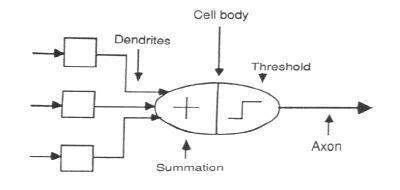
Artificial Neural Networks have historically focussed on modeling the brain as a collection of interconnected neurons. The individual neurons aggregate inputs and either produce an on/off output based on threshold values or produce a more complex output as a linear or sigmoid function of their inputs. The output of one neuron may go to several other neurons.


Not all inputs are equivalent and the inputs to the neuron are weighed according to a weight assigned to that input connection. This mimics the concept of synaptic strength. The weights can be positive (signifying an Excitatory Post-Synaptic Potential ) or negative (signifying an Inhibitory Post-Synaptic Potential).


Learning consists of the determination of correct weights that need to be assigned to solve the problem; i.e. to produce a desired output, given a particular input. This weight adjustment mimics the increase or decrease of synaptic strengths due to learning. Learning may also be established by manipulating the threshold required by the neuron for firing. This mimics the concept of long term potentiation (LTP).


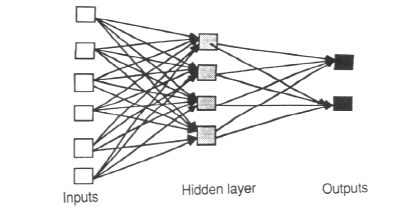
The model generally consists of an input layer (mimicking sensory inputs to the neurons) , a hidden layer (mimicking the association functions of the neurons in the larger part of the brain) and an output layer ( mimicking the motor outputs for the neurons).


This model is a very nice replication of the actual neurons and neuronal computation, but it ignores some of the other relevant features of actual neurons:

1. Neuronal inputs are added together through the processes of both spatial and temporal summation. Spatial summation occurs when several weak signals are converted into a single large one, while temporal summation converts a rapid series of weak pulses from one source into one large signal. The concept of temporal summation is generally ignored. The summation consists exclusively of summation of signals from other neurons at the same time and does not normally include the concept of summation across a time interval.

2. Not all neuronal activity is due to external 'inputs'. Many brain regions show spontaneous activity, in the absence of any external stimulus. This is not generally factored in. We need a model of brain that takes into account the spontaneous 'noise' that is present in the brain, and how an external 'signal' is perceived in this 'noise'. Moreover, we need a model for what purpose does this 'noise' serve?

3. This model mimics the classical conditioning paradigm, whereby learning is conceptualized in terms of input-output relationships or stimulus-response associations. It fails to throw any light on many operant phenomenon and activity, where behavior or response is spontaneously generated and learning consist in the increase\decrease \ extinction of the timing and frequency of that behavior as a result of a history of reinforcement. This type of learning accounts for the majority of behavior in which we are most interested- the behavior that is goal directed and the behavior that is time and context and state-dependent. The fact that a food stimulus, will not always result in a response 'eat', but is mediated by factors like the state (hunger) of the organism, time-of-day etc. is not explainable by the current models.

4. The concept of time, durations and how to tune the motor output as per strict timing requirements has largely been an unexplored area. While episodic learning and memory may be relatively easier to model in the existing ANNs, its my hunch that endowing them with a procedural memory would be well nigh impossible using existing models.


Over a series of posts, I would try to tackle these problems by enhancing the existing neural networks by incorporating some new features into it, that are consistent with our existing knowledge about actual neurons.

First, I propose to have a time-threshold in each neural unit. This time-threshold signifies the duration in which temporal summation is applicable and takes place. All inputs signals, that are received within this time duration, either from repeated firing of the same input neuron or from time-displaced firings of different input neurons, are added together as per the normal input weights and if at any time this reaches above the normal threshold-for-firing, then the neuron fires. This has combined both temporal and spatial summation concepts. With temporal summation, we have an extra parameter- the time duration for which the history of inputs needs to be taken into account.

All neurons will also have a very short-term memory, in the sense that they would be able to remember the strengths of the inputs signals that they have received in the near past , that is in the range of the typical time-thresholds that are set for them. This time-threshold can typically be in milliseconds.

Each time a neuron receives an input, it starts a timer. This timer would run for a very small duration encoded as the time-threshold for that neuron. Till the time this timer is running and has not expired, the input signal is available to the neuron for calculation of total input strength and for deciding whether to fire or not. As soon as the timer expires, the memory of the associated input is erased from the neurons memory and that particular input would no longer be able to affect any future firing of the neuron.

All timers as well as the memory of associated input signals are erased after each successful neural firing (every time the neuron generates an action potential). After each firing, the neuron starts from afresh and starts accumulating and aggregating the inputs it receives thereafter in the time-threshold window that is associated with it.

Of course there could be variations to this. Just like spatial aggregation/firing need not be an either/or decision based on a threshold; the temporal aggregation/ firing need not be an either-or decision: one could have liner or sigmoid functions of time that modulate the input signal strength based on the time that has elapsed. One particular candidate mechanism could be a radioactive decay function, that decreases the input signal strength by half after each half-life. Here, the half-life is equivalent to the concept of a time-threshold. While in the case of time-threshold, after a signal arrives, and once the time-threshold has elapsed, then the input signal is not available to the neuron at all, and while the time-threshold had not elapsed the signal was available in its entirety; in the case of radioactive deacy the inpiut signal is available till infinity in theory; but the strength of the signal would get diminisehd by half after each half-life period; thus making the effects of the input signal negligible after a few half-lives. Of course in the radioactive case too, once the neuron has fired, all memory of that input would be erased and any half-life decay computations stopped.

These are not very far-fetched speculations and modeling the neural networks this way can lead to many interesting results.

Second, I propose to have some 'clocks' or 'periodic oscillators' in the network, that would be generating spontaneous outputs after a pre-determined time and irrespective of any inputs. Even one such clock is sufficient for our discussions. Such a clock or oscillator system is not difficulty to envisage or conceive. We just need a non-random, deterministic delay in the transmission of signals from one neuron to the other. There do exist systems in the brain that delay the signals, but leaving aside such specialized systems, even a normal synaptic transmission along an axon between two neurons, would suffer from some deterministic delay based on the time it takes the signal to travel down the axon length and assuming that no changes in myelination takes place over time, so that the speed of transmission is constant.

In such a scenario, the time it takes for a signal to reach the other neuron, is held constant over time. (Note that this time may be different for different neuron pairs based on both the axon lengths involved and the associated myelination, but would be same for the same neuron pair over time). Suppose that both the neurons have very long, unmyelinated axons and that these axons are equal in length and provide inputs to each other. Further suppose that both the neurons do not have any other inputs , though each may send its output to many other neurons.

Thus, the sole input of the first neuron is the output of the second neuron and vice versa. Suppose that the thresholds of the two neurons are such that each would trigger, if it received a single input signal (from the peer neuron). As there would be a time lag between the firing of neuron one, and its reaching the second neuron, the second neuron would fire only after, say 5 milliseconds, the time it takes for signal to travel, after the first neuron has fired. The first neuron meanwhile will respond to the AP generated by the second neuron -which would reach it after (5+5= 10 ms) the round trip delay- and generate an AP after 10 ms from its initial firing.

We of course have to assume that somehow, the system was first put in motion: someone caused the first neuron to fire initially (this could not be other neurons, as we have assumed that this oscillator pair has no external input signals) and after that it is a self-sustaining clock with neuron 1 and neuron 2 both firing regularly at 10 ms intervals but in opposite phases. We just need GOD to initally fire the first neuron (the park of life) and thereafter we do have a periodic spontaneous activity in the system.

Thirdly, I propose that this 'clock', along with the concept of temporal summations, is able to calculate and code any arbitrary time duration and any arbitrary time dependent behavior, but in particular any periodic or sate/ goal based behavior. I've already discussed some of this in my previous posts and elaborate more in subsequent posts.

For now, some elementary tantalizing facts.
1. Given a 10 ms clock and a neuron capable of temporal summation over 50 ms duration, we can have a 50 ms clock: The neuron has the sole input as the output of the 10ms clock. After every 50 ms, it would have accumulated 5 signals in its memory. If the threshold-for-firing of the neuron is set such that it only fires if it has received five time the signal strength that is outputted by the 10 ms clock , then this neuron will fire after very 50 ms. This neuron would generate a periodic output after every 50 ms and implements a 50 ms clock.

2. Given a 10 ms clock and a neuron capable of temporal summation over 40 ms, (or lets have the original 50 ms time-threshold neuron, but set its threshold-for-firing to 4 times the output strength of the 10 ms clock neuron) , using the same mechanism as defined above, we can have a 40 ms clock.

3. Given a 40 ms clock, a 50 ms clock and a neuron that does not do temporal summation, we can have a 2000 ms clock. The sole inputs to the neuron implementing the 2000 ms clock are the outputs of the 50 ms and the 40 ms clock. This neuron does not do temporal summation. Its threshold for firing is purely spatial and it fires only if it simultaneously receives a signal strength that is equal to or greater than the combined output signal strength of 50ms and 40 ms neuron. It is easy to see, that if we assume that the 50 ms and 40 ms neurons are firing in phase, then only after every 2000 ms would the signals from the two neurons arrive at the same time for this 2000ms clock. Viola, we have 2000 ms clock. After this, I assume, its clear that the sky is the limit as to the arbitrariness of the duration that we can code for.

Lastly, learning consists of changing the temporal thresholds associated with a neuron, so that any arbitrary schedule can be associated with a behavior, based on the history of reinforcement. After the training phase, the organism would exhibit spontaneous behavior that follows a schedule and could learn novel schedules for novel behaviors (transfer of learning).

To me all this seems very groundbreaking theorizing and I am not aware of how and whether these suggestions/ concepts have been incorporated in existing Neural Networks. Some temporal discussions I could find here. If anyone is aware of such research , do let me know via comments or by dropping a mail. I would be very grateful. I am especially intrigued by this paper (I have access to abstract only) and the application of temporal summation concepts to hypothalamic reward functions.


Sphere: Related Content

Monday, November 13, 2006

synapse issue 11 is out ! : Call for submission for Encephalon no. 11

The latest issue of the Synapse is now available at the Developing Intelligence. There are many good articles, my favorite being the shame-guilt discussions at the AlphaPsy.

Encephalon # 11, would be hosted right here, at The Mouse Trap, on the 20th of November. So please send in your submissions as soon as possible, but not later than midnight of 19th November. Submission guidelines can be found here. You can also send your submissions directly to encephalon.host@gmail.com or to sandygautam---AT---yahoo---DOT---com.


Sphere: Related Content

Friday, November 10, 2006

Zombies, AI and Temporal Lobe Epilepsy : towards a universal consciousness and behavioral grammar?

I was recently reading an article on Zombies about how the Zombie argument has been used against physicalism and in consciousness debates in general, and one quote by Descartes at the beginning of the article captured my attention :

Descartes held that non-human animals are automata: their behavior is explicable wholly in terms of physical mechanisms. He explored the idea of a machine which looked and behaved like a human being. Knowing only seventeenth century technology, he thought two things would unmask such a machine: it could not use language creatively rather than producing stereotyped responses, and it could not produce appropriate non-verbal behavior in arbitrarily various situations (Discourse V). For him, therefore, no machine could behave like a human being. (emphasis mine)


To me this seems like a very reasonable and important speculation: although we have learned a lot about how we are able to generate an infinite variety of creative sentences using the generative grammar theory of Chomsky (I must qualify, we only know how to create a new grammatically valid sentence-the study of semantics has not complimented the study in syntax - so we still do not know why we are also able to create meaningful sentences and not just grammatically correct gibberish like "Colorless green ideas flow furiously" : the fact that this grammatically correct sentence is still interpretable by using polysemy , homonymy or metaphorical sense for 'colorless', 'green' etc may provide the clue for how we map meanings -the conceptual Metaphor Theory- but that discussion is for another day), we still do not have a coherent theory of how and why we are able to produce a variety of behavioral responses in arbitrarily various situations.

If we stick to a physical, brain-based, reductionist, no ghost-in-the-machine, evolved-as-opposed-to-created view of human behavior, then it seems reasonable that we start from the premise of humans as an improvement over the animal models of stimulus-response (classical conditioning) or response-reinforcement (operant conditioning) theories of behavior and build upon them to explain how and what mechanism Humans have evolved to provide a behavioral flexibility as varied, creative and generative as the capacity for grammatically correct language generation. The discussions of behavioral coherence, meaningfulness, appropriateness and integrity can be left for another day, but the questions of behavioral flexibility and creativity need to be addressed and resolved now.

I'll start with emphasizing the importance of response-reinforcement type of mechanism and circuitry. Unfortunately most of the work I am familiar with regarding the modeling of human brain/mind/behavior using Neural Networks focuses on the connectionist model with the implicit assumption that all response is stimulus driven and one only needs to train the network and using feedback associate a correct response with a stimulus. Thus, we have an input layer for collecting or modeling sensory input, a hidden association layer and an output layer that can be considered as a motor effector system. This dissociation of input acuity, sensitivity representation in the form of input layer ; output variability and specificity in the form of an output layer; and one or more hidden layers that associate input with output and may be construed as an association layer maps very well to our intuitions of a sensory system, a motor system and an association system in the brain to generate behavior relevant to external stimuli/situations. However, this is simplistic in the sense that it is based solely on stimulus-response types of associations (the classical conditioning) and ignores the other relevant type of association response-reinforcement. Let me clarify that I am not implying that neural networks models are behavioristic: in the form of hidden layers they leave enough room for cognitive phenomenon, the contention is that they not take into account the operant conditioning mechanisms. Here it is instructive to note that feedback during training is not equivalent to operant-reinforcement learning: the feedback is necessary to strengthen the stimulus-response associations; the feedback only indicates that a particular response triggered by the particular stimuli was correct.


For operant learning to take place, the behavior has to be spontaneously generated and based on the history of its reinforcement its probability of occurrence manipulated. This takes us to an apparently hard problem of how behavior can be spontaneously generated. All our life we have equated reductionism and physicalism with determinism, so a plea to spontaneous behavior seems almost like begging for a ghost-in-the-machine. Yet on careful thinking the problem of spontaneity (behavior in absence of stimulus) is not that problematic. One could have a random number generator and code for random responses as triggered by that random number generator. One would claim that introducing randomness in no way gives us 'free will', but that is a different argument. What we are concerned with is spontaneous action, and not necessarily, 'free' or 'willed' action.

To keep things simple, consider a periodic oscillator in your neural network. Lets us say it has a duration of 12 hours and it takes 12 hours to complete one oscillation (i.e. it is a simple inductor-capacitor pair and it takes 6 hours for capacitor to discharge and another 6 hours for it to recharge) ; now we can make connections a priori between this 12 hr clock in the hidden layer and one of the outputs in the output layer that gets activated whenever the capacitor has fully discharged i.e. at a periodic interval of 12 hours. Suppose that this output response is labeled 'eat'. Thus we have coded in our neural networks a spontaneous mechanism by which it 'eats' at 12 hour durations.

Till now we haven't really trained our neural net, and moreover we have assumed a circuitry like a periodic oscillator in the beginning itself, so you may object to this saying this is not how our brain works. But let us be reminded that just like normal neurons in the brain which form a model for neurons in the neural network, there is also a suprachiasmatic nuclei that gives rise to circadian rhythms and implements a periodic clock.

As for training, one can assume the existence of just one periodic clock of small granularity, say 1 second duration in the system, and then using accumulators that code for how many ticks have elapsed since past trigger, one can code for any arbitrary periodic response of greater than one second granularity. Moreover, one need not code for such accumulators: they would arise automatically out of training from the other neurons connected to this 'clock' and lying between the clock and the output layer. Suppose, that initially, to an output marked 'eat' a one second clock output is connected (via intervening hidden neuron units) . Now, we have feedback in this system also. Suppose, that while training, we provide positive feedback only on 60*60*12 trials (and all its multiples) and provide negative feedback on all other trials, it is not inconceivable to believe that an accumulator neural unit would get formed in the hidden layer and count the number of ticks that come out of the clock: it would send the trigger to output layer only on every 60*60*12 th trial and suppress the output of the clock on every other trial. Viola! We now have a 12 hour clock (which is implemented digitally using counting ticks) inside our neural network coding for a 12 hour periodic response. We just needed to have one 'innate' clock mechanism and using that and the facts of 'operant conditioning' or 'response-reinforcement' pairing we can create an arbitrary number of such clocks in our body/brain. Also, please notice the fact, that we need just one 12 hour clock, but can flexibly code for many different 12 hour periodic behaviors. Thus, if the 'count' in accumulator is zero, we 'eat'; if the count is midway between 0 and 60*60*12, we 'sleep'. Thus, though both eating and sleeping follow a 12 hour cycle, they do not occur concurrently, but are separated by a 6 hour gap.

Suppose further, that one reinforcement that one is constantly exposed to and that one uses for training the clock is 'sunlight'. The circadian clock is reinforced, say only by the reinforcement provided by getting exposed to the mid noon sun, and by no other reinforcements. Then, we have a mechanism in place for the external tuning of our internal clocks to a 24 hour circadian rhythm. It is conceivable, that for training other periodic operant actions, one need not depend on external reinforcement or feedback, but may implement an internal reinforcement mechanism. To make my point clear, while 'eat' action, i.e. a voluntary operant action, may get generated randomly initially, and in the traditional sense of reinforcement, be accompanied by intake of food, which in the classical sense of the word is a 'reinforcement'; the intake of food, which is part-and-parcel of the 'eat' action should not be treated as the 'feedback' that is required during training of the clock. During the training phase, though the operant may be activated at different times (and by the consequent intake of food be intrinsically reinforced) , the feedback should be positive only for the operant activations inline with the periodic training i.e. only on trials on which the operant is produces as per the periodic training requirement; and for all other trails negative feedback should be provided. After the training period, not only would operant 'eat' be associated with a reinforcement 'food': it would also occur as per a certain rhythm and periodicity. The goal of training here is not to associate a stimulus with a response ( (not the usual neural networks association learning) , but to associate a operant (response) with a schedule(or a concept of 'time'). Its not that revolutionary a concept, I hope: after all an association of a stimulus (or 'space') with response per se is meaningless; it is meaningful only in the sense that the response is reinforced in the presence of the stimulus and the presence of the stimulus provides us a clue to indulge in a behavior that would result in a reinforcement. On similar lines, an association of a response with a schedule may seem arbitrary and meaningless; it is meaningful in the sense that the response is reinforced in the presence of a scheduled time/event and the occurrence of the scheduled time/event provides us with a reliable clue to indulge in a behavior that would result in reinforcement.

To clarify, by way of an example, 'shouting' may be considered as a response that is normally reinforcing, because of say its being cathartic in nature . Now, 'shouting' on seeing your spouse''s lousy behavior may have had a history of reinforcement and you may have a strong association between seeing 'spouse's lousy behavior' and 'shouting'. You thus have a stimulus-response pair. why you don't shout always, or while say the stimuli is your 'Boss's lousy behavior', is because in those stimulus conditions, the response 'shouting', though still cathartic, may have severe negative costs associated, and hence in those situations it is not really reinforced. Hence, the need for an association between 'spouse lousy behavior' and 'shouting' : only in the specific stimulus presence is shouting reinforcing and not in all cases.

Take another example that of 'eating', which again can be considered to be a normally rewarding and reinforcing response as it provides us with nutrition. Now, 'eating' 2 or 3 times in a day may be rewarding; but say eating all the time, or only on 108 hours periodicity may not be that reinforcing a response, because that schedule does not take care of our body requirements. While eating on a 108 hours periodicity would impose severe costs on us in terms of under nutrition and survival, eating on 2 mins periodicity too would not be that reinforcing. Thus, the idea of training of spontaneous behaviors as per a schedule is not that problematic.

Having taken a long diversion, arguing for a case for 'operant conditioning' based training of neural networks, let me come to my main point.

While 'stimulus' and the input layer represent the external 'situation' that the organism is facing, the network comprising of the clocks and accumulators represent the internal state and 'needs' of the organism. One may even claim, a bit boldly, that they represent the goals or motivations of the organism.

A 'eat' clock that is about to trigger a 'eat' response, may represent a need to eat. This clock need not be a digital clock, and only when the 12 hour cycle is completed to the dot, an 'eating' act triggered. Rather, this would be a probabilistic, analog clock, with the 'probability' of eating response getting higher as the 12 hour cycle is coming to an end and the clock being rest, whenever the eating response happens. If the clock is in the early phases of the cycle (just after an eating response) then the need for eating (hunger) is less; when the clock is in the last phases of the cycle the hunger need is strong and would likely make the 'eating' action more and more probable.

Again, this response-reinforcement system need not be isolated from the stimulus-response system. Say, one sees the stimulus 'food', and the hunger clock is still showing 'medium hungry'. The partial activation of the 'eat' action (other actions like 'throw the food', ignore the food, may also be activated) as a result of seeing the stimulus 'food' may win over other competing responses to the stimuli, as the hunger clock is still activating a medium probability of 'hunger' activation and hence one may end up acting 'eat'. This however, may reset the hunger clock and now a second 'food' stimulus may not be able to trigger 'eat' response as the activation of 'eat' due to 'hunger clock' is minimal and other competing actions may win over 'eat'.

To illustrate the interaction between stimulus-response and response-reinforcement in another way, on seeing a written word 'hunger' as stimulus, one consequence of that stimulus could be to manipulate the internal 'hunger clock' so that its need for food is increased. this would be simple operation of increasing the clock count or making the 'need for hunger' stronger and thus increasing the probability of occurrence of 'eat' action.

I'll also like to take a leap here and equate 'needs' with goals and motivations. Thus, some of the most motivating factors for humans like food, sex, sleep etc can be explained in terms of underlying needs or drives (which seem to be periodic in nature) and it is also interesting to note that many of them do have cycles associated with them and we have sleep cycles or eating cycles and also the fact that many times these cycles are linked with each other or the circadian rhythm and if the clock goes haywire it has multiple linked effects affecting all the motivational 'needs' spectrum. In a mainc pahse one would have low needs to sleep, eat etc, while the opposite may be true in depression.

That brings me finally to Marvin Minsky and his AI attempts to code for human behavioral complexity.

In his analysis of the levels of mental activity, he starts with the traditional if, then rule and then refines it to include both situations and goals in the if part.


To me this seems intuitively appealing: One needs to take into account not only the external 'situation', but also the internal 'goals' and then come up with a set of possible actions and maybe a single action that is an outcome of the combined 'situation' and 'goals' input.

However, Minsky does not think that simple if-then rules, even when they take 'gaols' into consideration would suffice, so he posits if-then-result rules.
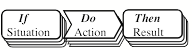
To me it is not clear how introducing a result clause makes any difference: Both goals and stimulus may lead to multiple if-then rule matches and multiple actions activation. These action activations are nothing but what Minsky has clubbed in the result clause and we still have the hard problem of given a set of clauses, how do we choose one of them over other.

Minsky has evidently thought about this and says:

What happens when your situation matches the Ifs of several different rules? Then you’ll need some way to choose among them. One policy might arrange those rules in some order of priority. Another way would be to use the rule that has worked for you most recently. Yet another way would be to choose rules probabilistically.


To me this seems not a problem of choosing which rule to use, but that of choosing which response to choose given several possible responses as a result of application of several rules to this situation/ goal combination. It is tempting to assume that the 'needs' or 'gaols' would be able to uniquely determine the response given ambiguous or competing responses to a stimulus; yet I can imagine a scenario where the 'needs' of the body do not provide a reliable clue and one may need the algorithms/heuristics suggested by Minsky to resolve conflicts. Thus, I see the utility of if-then-result rules: we need a representation of not only the if part (goals/ stimulus) in the rule; which tells us what is the set of possible actions that can be triggered by this stimulus/ situation/ needs combo; but also a representation of the results part of the rule: which tells us what reinforcement values these response(actions) have for us and use this value-response association to resolve the conflict and choose one response over the other. This response-value association seems very much like the operant-reinforcement association, so I am tempted once more to believe that the value one ascribes to a response may change with bodily needs and rather is reflective of bodily needs, but I'll leave that assumption for now and instead assume that somehow we do have different priorities assigned to the responses ( and not rules as Minsky had originally proposed) and do the selection on the basis of those priorities.

Though I have posited a single priority-based probabilistic selection of response, it is possible that a variety of selection mechanisms and algorithms are used and are activated selectively based on the problem at hand.

This brings me to the critic-selector model of mind by Minsky. As per this model, one needs both critical thinking and problem solving abilities to act adaptively. One need not just be good at solving problems- one also has to to understand and frame the right problem and then use the problem solving approach that is best suited to the problem.
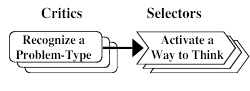

Thus, the first task is to recognize a problem type correctly. After recognising a problem correctly, we may apply different selctors or problem solving strategies to different problems.

He also posits that most of our problem solving is analogical and not logical. Thus, the recognizing problem is more like recognizing a past analogical problem; and the selecting is then applying the methods that worked in that case onto this problem.

How does that relate to our discussions of behavioral flexibility? I believe that every time we are presented with a stimulus or have to decide how to behave in response to that stimulus, we are faced with a problem- that of choosing one response over all others. We need to activate a selection mechanism and that selection mechanism may differ based on the critics we have used to define the problem. If the selection mechanism was fixed and hard-wired then we wont have the behavioral flexibility. Because the selection mechanism may differ based on our framing of the problem in terms of the appropriate critics, hence our behavioral response may be varied and flexible. At times, we may use the selector that takes into account only the priorities of different responses in terms of the needs of the body; at other times the selector may be guided by different selection mechanisms that involve emotions and values us the driving factors.

Minsky has also built a hierarchy of critics-selector associations and I will discuss them in the context of developmental unfolding in a subsequent post. For now, it is sufficient to note that different types of selection mechanisms would be required to narrow the response set, under different critical appraisal of the initial problem.
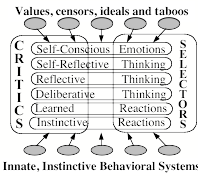
To recap, a stimulus may trigger different responses simultaneously and a selection mechanism would be involved that would select the appropriate response based on the values associated with the response and the selection algorithm that has been activated based on our appraisal of the reason for conflicting and competing responses. while critics help us formulate the reason for multiple responses to the same stimuli, the selector helps us to apply different selection strategies to the response set, based on what selection strategy had worked on an earlier problem that involved analogous critics.

One can further dissociate this into two processes: one that is grammar-based, syntactical and uses the rules for generating a valid behavioral action based on the critic and selector predicates and the particular response sets and strategies that make up the critic and selector clause respectively. By combining and recombining the different critics and selectors one can make an infinite rules of how to respond to a given situation. Each such rule application may potentially lead to different action. The other process is that of semantics and how the critics are mapped onto the response sets and how selectors are mapped onto different value preferences.

Returning back to the response selection, given a stimulus, clearly there are two processes at work : one that uses the stored if-then rules (the stimulus-response associations) to make available to us a set of all actions that are a valid response to the situation; and the other that uses the then-result rules (and the response-value associations, that I believe are dynamic in nature and keep changing) to choose one of the response from that set as per the 'subjective' value that it prefers at the moment. This may be the foundation for the 'memory' and 'attention' dissociations in working memory abilities used in stroop task and it it tempting to think that the while DLPFC and the executive centers determine the set of all possible actions (utilizing memory) given a particular situation, the ACC selects the competing responses based on the values associated and by selectively directing attention to the selected response/stimuli/rule.


Also, it seems evident that one way to increase adaptive responses would be to become proficient in discriminating stimuli and perceiving the subjective world accurately; the other way would be to become more and more proficient in directing attention to a particular stimulus/ response over others and directing attention to our internal representations of them so that we can discriminate between the different responses that are available and choose between them based on an accurate assessment of our current needs/ goals.


This takes me finally to the two types of consciousness that Hughlings-Jackson had proposed: subject consciousness and object consciousness.


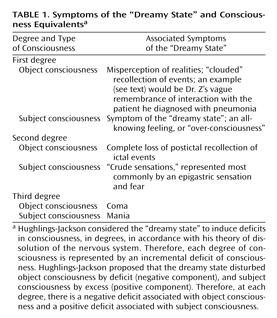
Using his ideas of sensorimotor function, Hughlings-Jackson described two "halves" of consciousness, a subject half (representations of sensory function) and an object half (representations of motor function). To describe subject consciousness, he used the example of sensory representations when visualizing an object . The object is initially perceived at all sensory levels. This produced a sensory representation of the object at all sensory levels. The next day, one can think of the object and have a mental idea of it, without actually seeing the object. This mental representation is the sensory or subject consciousness for the object, based on the stored sensory information of the initial perception of it.

What enables one to think of the object? This is the other half of consciousness, the motor side of consciousness, which Hughlings-Jackson termed "object consciousness." Object consciousness is the faculty of "calling up" mental images into consciousness, the mental ability to direct attention to aspects of subject consciousness. Hughlings-Jackson related subject and object consciousness as follows:

The substrata of consciousness are double, as we might infer from the physical duality and separateness of the highest nervous centres. The more correct expression is that there are two extremes. At the one extreme the substrata serve in subject consciousness. But it is convenient to use the word "double."

Hughlings-Jackson saw the two halves of consciousness as constantly interacting with each other, the subjective half providing a store of mental representations of information that the objective half used to interact with the environment.

Further,


The term "subjective" answers to what is physically the effect of the environment on the organism; the term "objective" to what is physically the reacting of the organism on the environment.


Hughlings-Jackson's concept of subjective consciousness is akin to the if-then representation of mental rules.One needs to perceive the stimuli as clearly as possible and to represent them along with their associated actions so that an appropriate response set can be activated to respond to the environment. His object consciousness is the attentional mechanism that is needed to narrow down the options and focus on those mental representations and responses that are to be selected and used for interacting with the environment.

As per him, subject and object consciousness arise form a need to represent the sensations (stimuli) and movements (responses) respectively and this need is apparent if our stimulus-response and response-reinforcement mappings have to be taken into account for determining appropriate action.

All nervous centres represent or re-represent impressions and movements. The highest centres are those which form the anatomical substrata of consciousness, and they differ from the lower centres in compound degree only. They represent over again, but in more numerous combinations, in greater complexity, specialty, and multiplicity of associations, the very same impressions and movements which the lower, and through them the lowest, centres represent.


He had postulated that temporal lobe epilepsy involves a loss in objective consciousness (leading to automatic movements as opposed to voluntary movements that are as per a schedule and do not happen continuously) and a increase in subjective consciousness ( leading to feelings like deja-vu or over-consciousness in which every stimuli seems familiar and triggers the same response set and nothing seems novel - the dreamy state). These he described as the positive and negative symptoms or deficits associated with an epileptic episode.
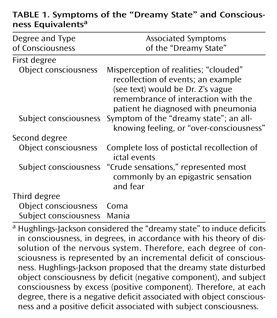
It is interesting to note that one of the positive symptom he describes of epilepsy, that is associated with subjective consciousness of third degree, is 'Mania' : the same label that Minsky uses for a Critic in his sixth self-consciousness thinking level of thinking. The critic Minsky lists is :

Self-Conscious Critics. Some assessments may even affect one’s current image of oneself, and this can affect one’s overall state:

None of my goals seem valuable. (Depression.)
I’m losing track of what I am doing. (Confusion.)

I can achieve any goal I like! (Mania.)
I could lose my job if I fail at this. (Anxiety.)

Would my friends approve of this? (Insecurity.)


Interesting to note that this Critic or subjective appraisal of the problem in terms of Mania can lead to a subjective consciousness that is characterized as Mania.

If Hughlings-Jackson has been able to study epilepsy correctly and has been able to make some valid inferences, then this may tell us a lot about how we respond flexibly to novel/ familiar situations and how the internal complexity that is required to ensure flexible behavior, leads to representational needs in brain, that might lead to the necessity of consciousness.


Sphere: Related Content

Thursday, November 09, 2006

Kumbhakaran's discovered

A rare sleep disorder has come to light wherein people may sleep continuously for days. The longest reported spell is still about a month long and nowhere near the legendary six-month sleep that Khumkharna used to have.

Thankfully, sleeping for a day or two during the weekend is not counted as symptom of the disease, or I too might qualify (and I know of many others who would!).

Interestingly, there is also a familial fatal insomnia that has an underlying Prion mechanism and in which, once the illness is triggered you are unable to sleep, until you eventually die after about 15 months of sleep deprivation.

Hat-tip: The Frontal Cortex

Sphere: Related Content

Insanity in Films: A Rendezvous with Madness

Insanity has been typically depicted in a very stereotyped manner in both Bollywood as well as Hollywood. Moreover, the depiction is often insensitive and hackneyed, with the consequent stigmatization of all mental health issues.

While some recent Bollywood films like "Black" have drawn attention to some oft ignored neurological disorders like Alzheimer's; it is the depiction of schizophrenia and mental wards/asylums that has remained problematic.

While an occasional flick like "A beautiful mind" or"15 park Avenue" may end up portraying the schizophrenic condition sensitively and realistically, for each such film there are countless other films that associate the disorder with violence, bad intrusive thoughts and character defects of the protagonist. Thus, in my view, the need for films that provide a positive spin to the disease and counter the negative stereotype.

"Lago Raho Munnabhai" is one such film and it does so in a very subtle manner. While the film has been getting rave reviews for reviving Gandhian values and for making them trendy and cool for the Generation X by reincarnating those values as Gandhigiri, it has also been successful in making people sympathize with the Schizophrenic condition and do away with their prejudices that the auditory/visual hallucination accompanying Schizophrenia have to be negative/disturbing in nature. In this movie, Gandhi appears as a hallucination and guides Munna as per Gasndhian values , to resolve everyday problems.

The trigger of the illness in Munna, following some sleepless,no-nutrition, stressful days and nights, reading Gandhian Literature to the exclusion of everything else, is quite realistic and highlights some of the things that those vulnerable to schizophrenia need to avoid, to prevent relapse or triggering of the illness. The implied assertion that the 'split personality' may be due to a split between the Gandhian values that Munna has recently learned, and his old Bhai style violence-driven personality, though not technically correct as per current views, provides an antidote to the psychodynamic theories that posited that the disorder is a result of suppressing negative personality and thoughts: it is refreshing to consider the possibility that the negativity has so much shadowed our normal selves and become so common place, that if anything needs to be suppressed it would be positive and tender emotions and values.

The high point of the film is when Lucky Singh , the nemesis of Munna, launches an Ad Hominem attack on Munna and discredits all the good work he had done in spreading Gandhian values, by 'exposing' his insanity and by making him a laughing stock. Quite predictably, the general public in the movie leaves the side of Munna to let him fight his own devils (this time the devil is Gandhi:-), but surprisingly, the general public, that is the audience of the movie, stays with him and empathizes with him and laments not on his disease or his condition, but more so on the disease that is plaguing the Lucky Singhs of this world- that of corruption/ evil and on their own prejudices, insensitive and immature reaction to the 'insane'. If not for anything else, this alone should have ensured that this movie represented India in the Oscars rather than "Rang De Basanti".

Also heartening to note is, that though the film ends on a positive note, it doesn't offer any magical cure for Schizophrenia and makes it clear that Gandhi is there to stay with Munna. What it does manage to do is, that it rechristens the 'Furies' that tormented Orestes as 'Eumenides' or 'The Kindly ones' and by doing this 'cures' the real underlying disease- our prejudiced view of hallucinations as evil/tormenting/disturbing.

On a related note, the one conclusion that stands out in the Stephen Fry documentary "The Secret Life of the Manic-Depressive" is the strong reluctance of many suffering from the disease to pull the genetic switch (if there was one) that would have prevented them from their illness and all the resultant experiences. In the words of one of the people interviewed there, 'it is enough to have walked with angles, and everything else is a small price to play" (paraphrasing). While glamorization of mental illness is not exactly the right antidote to the pervasive stigmatization, yet an occasional association of positive affect, experiences and values with mental illness would go a long way in making us more sensitive and open about mental health issues.

There is a film festival being organized in Toronto, Rendezvous with Madness, showcasing some of the international films dealing with the mental health and stigmatization issues and hopefully its selection of movies is good. I find the section "Where there is Love there is Life" particularly interesting as the blurb contains reference to Gandhi.


Where There Is Love There Is Life: A Family Program
Mahatma Gandhi (1869-1948)


Where There Is Love There Is Life celebrates the resilience of children who struggle with loss and mental illness. This program of three Canadian shorts and a foreign feature presentation offers a hopeful portrait of such serious subjects as children caring for a mentally ill parent and also experiencing extreme anxiety. Themes like the power of forgiveness, the imagination, and of self-knowledge are introduced as tools for personal growth and survival in this mix of narrative drama and animation, which children and parents alike will find educational and entertaining. Rated PG.


It's sad that "Lage Raho Munnabhai" is not part of this festival, but I'm sure as an independent entry in the Oscars, it would be able to reach more audiences and destigmatize the issues surrounding mental health

Sphere: Related Content

Tuesday, November 07, 2006

Encephalon #10: A treat for your mind!

The latest edition of encephalon, the brain carnival, has just been published by Bora at A Blog Around The Clock.

It is a truly outstanding issue highlighting some of the best cognitive posts on the web.

My favorite picks are Gene Expression's excellent summary of the current view of Hippocampal formation as a memory consolidator and also as representing spatio-temporal information in the form of Cognitive Maps.

The readers of this blog will remember that this blog started with a cognitive map focus and it is heartening to see how the place and grid cell systems discovered in Hippcoampus may contribute to the different dissociated memory areas hypothesized in the hippocampus regarding novelty and similarity (recollection) memory retrieval. Incidentally, the novelty related area, found using fMRI, was the rhinal cortices and the grid cells are also found there! I would write a detailed mail linking everything up, but for now you may want to savor the other great articles in the Encephalon- another favorite being the exploration of peripersonal space in neglect patients by Michael.

Sphere: Related Content

Thursday, November 02, 2006

Incongruence perception and linguistic specificity: a case for a non-verbal stroop test

In a follow up to my last post on color memory and how it affects actual color perception, I would like to highlight a classical psychological study by Bruner and Postaman, that showed that even for non-natural artifacts like suits in a playing card deck, our expectation of the normal color or shape of a suit, affects our perception of a stimuli that is incongruent to our expectations.

In a nutshell, in this study incongruent stimuli like a red spade card or a black heart card was presented for brief durations and the subjects asked to identify the stimuli completely - the form or shape (heart/spade/club/diamond), the color (red/black) and the number( 1..10...face cards were not used) of the stimuli.

The trial used both congruent ( for eg a red heart, a black club) as well as incongruent stimuli (a black heart, a red spade).

To me this appears to be a form of stroop task , in which, if one assumes that form is a more salient stimulus than color, then a presentation of a spade figure would automatically activate the black color perception and the prepotent color naming response would be black, despite the fact that the spade was presented in red color. This prepotent 'black' verbal response would, as per standard stroop effect explanations, be inhibited for the successful 'red' verbal response to happen. I am making an analogy here that the form of a suit is equivalent to the linguistic color-term and that this triggers a prepotent response.


In these lights, the results of the experiment do seem to suggest a stroop effect in this playing-deck task, with subjects taking more trials to recognize incongruent stimuli as compared to congruent stimuli.


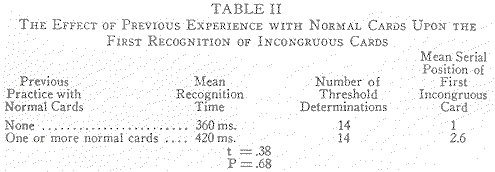
Perhaps the most central finding is that the recognition threshold for the incongruous playing cards (whose with suit and color reversed) is significantly higher than the threshold for normal cards. While normal cards on the average were recognized correctly -- here defined as a correct response followed by a second correct response -- at 28 milliseconds, the incongruous cards required 114 milliseconds. The difference, representing a fourfold increase in threshold, is highly significant statistically, t being 3.76 (confidence level < .01).


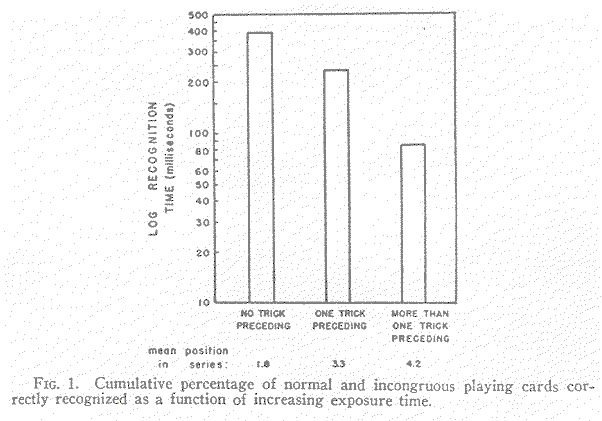
Further interesting is the fact that this incongruence threshold decreases if one or more incongruent trials precede the incongruent trial in question; or increases if the preceding trials are with normal cards. This is inline with current theories of stroop effect as involving both memory and attention, whereby the active maintenance of the goal (ignore form and focus on color while naming color) affects performance on all trials and also affects the errors , while the attentional mechanism to resolve incongruence affects only reaction times (and leads to RT interference).


As in the playing card study, no reaction time measures were taken, but only the threshold reached to correctly recognize the stimuli were used, so we don't have any RT measures, but a big threshold is indicative of and roughly equal to an error on a trial. The higher thresholds on incongruent trial means that the errors on incongruent trial were more than on congruent trials. The increase in threshold , when normal card precede and a decrease when incongruent cards precede is analogous to the high-congruency and low-congruency trials described in Kane and Engel study and analyzed in my previous posts as well as in a Developing Intelligence post. It is intuitive to note that when incongruent trials precede, then the goal (ignore form and focus on color while naming color) becomes more salient; when normal cards precede one may have RT facilitation and the (implicit) goal to ignore color may become less salient.

Experience with an incongruity is effective in so far as it modifies the set of the subject to prepare him for incongruity. To take an example, the threshold recognition time for incongruous cards presented before the subject has had anything else in the tachistoscope -- normal or incongruous -- is 360 milliseconds. If he has had experience in the recognition of one or more normal cards before being presented an incongruous stimulus, the threshold rises slightly but insignificantly to 420 milliseconds. Prior experience with normal cards does not lead to better recognition performance with incongruous cards (see attached Table ). If, however, an observer has had to recognize one incongruous card, the threshold for the next trick card he is presented drops to 230 milliseconds. And if, finally, the incongruous card comes after experience with two or three previously exposed trick cards, threshold drops still further to 84 milliseconds.

Thus clearly the goal maintenance part of stroop effect is clearly in play in the playing-card task and affects the threshold for correct recognition.


The second part of explanation of stroop task is usually based on directed inhibition and an attentional process that inhibits the perpotent response. This effect comes into play only on incongruent trials. An alternate explanation is that their is increased competition of competing representations on incongruent trials and instead of any top-down directed inhibition, inline with the goal/expectation, their is only localized inhibition. The dissociation of a top-down goal maintenance mechanism ad another attentional selection mechanism seems to be more inline with the new model, wherein inhibition is local and not top-directed.

While RT measures are not available it is intersecting to take a look at some of the qualitative data that supports a local inhibition and attentional mechanism involved in reacting to incongruent stimuli. The authors present evidence that the normal course of responses that are generated by the subjects for (incongruent) stimuli is dominance, compromise, disruption and finally recognition.

Generally speaking, there appear to be four kinds of reaction to rapidly presented incongruities. The first of these we have called the dominance reaction. It consists, essentially, of a "perceptual denial" of the incongruous elements in the stimulus pattern. Faced with a red six of spades, for example, a subject may report with considerable assurance, "the six of spades" or the "six of hearts," depending upon whether he is color or form bound (vide infra). In the one case the form dominates and the color is assimilated to it; in the other the stimulus color dominates and form is assimilated to it. In both instances the perceptual resultant conforms with past expectations about the "normal" nature of playing cards.

A second technique of dealing with incongruous stimuli we have called compromise. In the language of Egon Brunswik , it is the perception of a Zwischengegenstand or compromise object which composes the potential conflict between two or more perceptual intentions. Three examples of color compromise: (a) the red six of spades is reported as either the purple six of hearts or the purple six of spades; (b) the black four of hearts is reported as a "grayish" four of spades; (c) the red six of clubs is seen as "the six of clubs illuminated by red light."

A third reaction may be called disruption. A subject fails to achieve a perceptual organization at the level of coherence normally attained by him at a given exposure level. Disruption usually follows upon a period in which the subject has failed to resolve the stimulus in terms of his available perceptual expectations. He has failed to confirm any of his repertory of expectancies. Its expression tends to be somewhat bizarre: "I don't know what the hell it is now, not even for sure whether it's a playing card," said one frustrated subject after an exposure well above his normal threshold.

Finally, there is recognition of incongruity, the fourth, and viewed from the experimenter's chair, most successful reaction. It too is marked by some interesting psychological by-products, of which more in the proper place.

This sequence points towards a local inhibition mechanism in which either one of the responses is selected and dominates the other; or both the responses mix and yield to give a mixed percept ---this is why a gray banana may appear yellowish---or why a banana matched to gray background by subjects may actually be made bluish---as that of a blackish red perception of suit color; or in some cases there may be frustration when the incongruent stimuli cannot be adequately reconciled with expectations- leading to disruption- in the classical stroop task this may explain the skew in RT for some incongruent trials----some take a lot of time as maybe one has just suffered from disruption---; and finally one may respond correctly but only after a reasonable delay. This sequence is difficult to explain in terms of top-down expectation model and directed inhibition.

Finally, although we have been discussing the playing card task in terms of stroop effect, one obvious difference is striking. In the playing cards and t e pink-banana experiments the colors and forms or objects are tightly coupled- we have normally only seen a yellow banana or a red heart suit. This is not so for the printed grapheme and linguistic color terms- we have viewed then in all colors , mostly in black/gray- but the string hue association that we still have with those colors is on a supposedly higher layer of abstraction.

Thus, when an incongruent stimuli like a red heart is presented , then any of the features of the object may take prominence and induce incongruence in the other feature. For eg, we may give more salience to form and identity it as a black spade; alternately we may identify the object using color and perceive incongruence in shape- thus we may identify it as a red spade. Interestingly, both kind of errors were observed in the Bruner study. Till date, one hast not really focussed on the reverse stroop test- whereby one asks people to name the color word and ignore the actual color- this seems to be an easy task as the linguistic grapheme are not tied to any color in particular- the only exception being black hue which might be reasonably said to be associated with all grapheme (it is the most popular ink). Consistent with this, in this reverse stroop test, sometimes subjects may respond 'black' when watching a 'red' linguistic term in black ink-color. This effect would be for 'black' word response and black ink-color only and for no other ink color. Also, the response time for 'black' response may be facilitated when the ink-color is black (and the linguistic term is also 'black') compared to other ink-colors and other color-terms. No one has conducted such an experiment, but one can experiment and see if there is a small stroop effect involved here in the reverse direction too.

Also, another important question of prime concern is whether the stroop interference in both cases, the normal stroop test, and the playing card test, is due to a similar underlying mechanism, whereby due to past sensory (in case of playing cards) or semantic associations (in case of linguistic color terms) the color terms or forms (bananas/ suits) get associated with a hue and seeing that stimulus feature automatically activates a sensory or semantic activation of the corresponding hue. This prepotent response then competes with the response that is triggered by the actual hue of the presented stimulus and this leads to local inhibition and selection leading to stroop interference effects.

If the results of the non-verbal stroop test, comprising of natural or man-made objects, with strong color associations associated with them, results in similar results as observed in the classical stroop test, then this may be a strong argument for domain-general associationist/ connectionist models of language semantics and imply that linguistic specificity may be over hyped and at least the semantics part of language acquisition, is mostly a domain general process. On the other hand, dissimilar results on non-verbal stroop tests form the normal stroop test, may indicate that the binding of features in objects during perception; and the binding of abstract meaning to linguistic words in a language have different underlying mechanisms and their is much room for linguistic specificity. Otherwise, it is apparent that the binding of abstract meaning to terms is different a problem from that of binding of different visual features to represent and perceive an object. One may use methods and results from one field and apply them in the other.

To me this seems extremely interesting and promising. The evidence that stroop test is due to two processes - one attentional and the other goal maintenance/ memory mediated - and its replication in a non-verbal stroop tests, would essentially help us a lot by focusing research on common cognitive mechanisms underlying working memory - one dependent on memory of past associations and their active maintenance- whether verbal/abstract or visual/sensory- and the other dependent on a real-time resolution of incongruity/ambiguity by focusing attention on one response to the exclusion of the other. This may well correspond to the Gc and Gf measures of intelligence. One reflecting how good we are at handling and using existing knowledge; the other how good we are able to take into account new information and respond to novel situations. One may even extend this to the two dissociated memory mechanisms that have been observed in parahippocampal regions- one used when encountering familiar situations/stimuli and the other when encountering novel stimuli. One essentially a process of assimilation as per existing schema/ conceptual metaphors; the other a process of accommodation, involving perhaps, an appreciation/formation of novel metaphors and constructs.

Enough theorizing and speculations for now. Maybe I should act on this and make an online non-verbal stroop test instead to test my theories!

Endgame: Another interesting twist to the playing cards experiment could be in terms of motivated perception. Mixing Memory discusses another classical study by Bruner in this regard. Suppose that we manipulate motivations of people so that they are either expecting to see a heart or a red color as the next stimuli- because only this desired stimuli would yield them a desired outcome, say, orange juice; then in this case when presented with an incongruent stimuli - a red spade- would we be able to differentially manipulate the resolution of incongruence; that is those motivated to see red would report seeing a 'red spade' and those motivated to see a heart would report a 'black heart' . Or is the effect modality specific with effects on color more salient than on form. Is it easier to see a different color than it is to see a different form? And is this related to the modality specific Sham's visual illusion that has asymmetry in the sense that two beeps, one flash leads to perception of two flashes easily but not vice versa.

Sphere: Related Content