Wednesday, August 30, 2006

Synapse Edition 6 : A last call for submissions!

Fellow bloggers!

Its that time of year again, when one needs to take some time out, from the usual blogging activities, to submit one's most interesting posts, for inclusion in the next edition of that esteemed Carnival called Synapse. This is more important than any grant request that you may need to make. So don't forget to nominate your , or other bloggers, best entries from the past weeks for inclusion in the sixth edition of Synapse that would be published right here at The Mouse Trap on 3rd September.

Please submit the entries in time for inclusion on 3rd Septemeber. Submission guidelines here.

Sphere: Related Content

Different stages of pretend play and how they relate to language development

I was browsing through a blog post by Developing Intelligence and came across this link to a talk by Greenfield et al, regarding pretend play capabilities of Chimpanzees and Bonobos. In this, it is asserted that Chimpanzees and Bonobos are able to achieve level4 of pretend play, that is observed in Humans by themselves and if they are scaffolded or guided by Humans in their Zone of Proximal Development, they can also achieve the stage 5 (the highest stage achieved) . The levels were levels of pretend play as described by McCune and Agayoff (2002) and based on descriptions by Piaget (1951). No web searches by me could lead me to the definition of these levels on the web and I would be glad if any of the readers of this blog, who are familiar with these levels, could update me on this by posting in the comments.

However, I did come across some other levels or stages associated with pretend play and could link them up with my previous postings on moral, cognitive, perspective and language development.

To outline my position, I intend to show that pretend play or Symbolic play follows the same stages as involved in language acquisition and the analogy is true for both Language syntax as well as lexicon acquisition. Further, it may be the case, that pretend play stages precede corresponding language stages and are necessary for successful language acquisition in all stages.

First, I would like to distinguish between the form of pretend play and its contents. The form of pretend play may consist of different predicates

  • An Agent that is pretending (or the Role (R))
  • A pretentious or false act (this is the Pretense (P))
  • A false representation of an object (this is the substituted object (O))

Thus, a pretend play P = R P O


The child may start initially start by forming a concept of pretenses as something that is not really true (stage I); start creating pretenses with real life objects e.g. using real life objects in pretentious acts (like pretended talking on an actual mobile) (stage II); gradually combine two of these (using banana as a mobile and pretending to talk on it) (stage III); gradually graduate to elaborate pretensions whereby not only objects stand for something else and actions stand for something else, but also the role assumed by the child may vary, and is usually that of adults (stage IV); and in later stages the roles , object-representations etc may even be novel and not something that the child has encountered in its usual socializing (stage V).

This staged manner is analogous in language acquisition to babbling (whereby one starts creating words), one word speech (whereby one starts using a word for representing a thing), two word speech (whereby one combines actions, nouns etc in two word phrases to create sentences) and finally telegraphic speech (too much bound by rules learned from observation of adults) and finally adult speech based on pragmatics.

More interesting is some stages described in "Multiple Perspectives on Play in Early Childhood Education" By Olivia N Saracho, Bernard Spodek for individual lexicons- like that for object substitution.

Elena Bugrimenko and Elena Sminova have proposed five stages in symbolic play (ages 18 to 30 months)

  • Stage 1 : Children play only with realistic toys and show no interest in object substitution performed by adults
  • Stage 2: Children automatically imitate adult-initiated object substitutions, but do not appear to understand that one object has been substituted for other.
  • Stage 3: Children independently imitate object substitutions previously performed by an adult.
  • Stage4: Children initiate their own object substitutions, but do not rename the objects with substitute names
  • Stage 5: Children originate and rename


It is interesting to note that individual elements of a pretend play like object-substitution, themselves go through developmental stages.


Another interesting study mentioned in "Understanding Child Development: For Adults Who Work with Young Children" By Rosalind Charlesworth refers to the actual pretense act and how that pretense act becomes more complex as the child goes through different developmental stages. In the following example, the 'pretended act of feeding/eating' should be considered.

According to Nicolich(1977), toddlers develop through a sequence of stages in their play, as seen in the following example:

  • Stage 1: Rudy picks up a spoon, looks at it, puts in his mouth, hangs it on the floor, and drops it.
  • Stage2: Rudy picks up the spoon and pretends to eat.
  • Stage 3: Rudy uses the spoon to feed a doll.
  • Stage 4: Rudy mixes up some pretend food in a pan with the spoon. He uses the spoon to put some pretend food in a dish. He then proceeds to eat, using the same spoon.
  • Stage 5: Rudy goes to the shelf. He takes a plate, cup, and saucer and carefully places them on the table. He returns to the shelf and gets a spoon, knife and fork with which he completes the place setting. His mother sits at the table. Rudy says. 'Soup, mom'. He feeds her with the spoon.


It is interesting to observe that in the above examples, the child in stage 1 is developing his sensory-motor abilities to indulge in a pretend act of eating; in stage 2 he actually indulges in a pretend act that is directed towards himself. In stage 3, he directs the pretense act towards someone else ( a doll) , in stage 4 he goes through a sequence of activities and rituals as observed in a normal social context, in stage 5 he indulges in elaborate planning, setting up the stage and understands that other people can also pretend juts like him and directs the pretend act towards another human being.


To develop the staged theory of pretend play further, consider role-playing agent (that is the child indulging in pretense play). The discussion is based on the following stages (doc) available on the web. (italicized comments mine)

Stage I: Imitative Role Play: In this initial stage of play, children try to act, talk, and dress like people they know. Children use real objects as props. They depend on an element of reality in their play. For instance, a child may pick up a telephone and pretend to “talk on the phone like Mommy” or hold a doll and “feed the baby.” One starts developing a concept of a 'pretended role' but needs to ground that with the actual props that are used and this play is a solitary activity.

Stage II: Make-Believe Play: In the second stage, children’s play is enriched by their imaginations. Now less dependent on concrete props for role-playing, children may use a string as a firefighter’s hose, or an envelope may be Mommy’s briefcase. The ability to make-believe moves beyond the scope of real props or costumes. Children also learn to use their imaginations to invent actions and situations. Dramatic play is no longer confined to real-life events. At this stage, children often use such play to help them understand feelings or deal with fears and worries. Point to note that one has developed a concept of 'pretend roles' and does not need to depend on external props for achieving that role. The role-playing is still mostly a solitary activity.

Stage III: Socio-Dramatic Play: Socio-dramatic play emerges at the time children begin seeking the company of others. Socio-dramatic play includes elements of imitative play and make-believe play; however, it stands apart from the earlier stages in that it requires verbal interaction between two or more children. Because of its interactive nature, socio-dramatic play necessitates planning. One child chooses to be the teacher and the other the student; one child can be a firefighter and the other a would-be victim. Because of its more complex story lines, socio-dramatic play requires that children spend a significant amount of time in this type of play. This play, in my view, is characterized by role-play involving two persons. One knows what role one is supposed to play and what the other person has to play and one may even switch roles during the play. This marks the beginning of 'social' pretend play.

To the above stages I will add two of my own stages of role-playing:

Stage IV : Mythological/ Archetypal / adult role playing
: Here the child may enact the different roles played by mythological or archetypal characters that are prevalent in his culture. He may one minute play Ravana, the next Rama, the next Laxmana, the next Jatauyu and the next Sita (all characters of Ramayana). Thus, he starts understanding that one may have different roles and pretenses at different times and a typical sequence of play would involve permuting between different roles in succession. One is exposed to not only the fact that different roles can be assumed sequentially, but also gets exposed to how it feels to act in that particular social role that is prevalent in one's culture. One would normally imitate adult roles and also play with adults (mother) in this role-playing.

Stage V: Novel role-playing: Here the role-playing with peers becomes more important. Also one seeks novel roles like that of an Alien invader and uses the imagination to come up with novel pretend roles. One may pretend to be novel animals - an El-zebra - an elephant that has stripes and runs very fast. One may pretend not to be a 'role' like a doctor, but a 'person' like one’s best friend and say that I am Bill and act like Bill (for e.g. cuddling dolls like Bill does). Thus, one may move from 'pretend roles' to pretend persons' and even go on the do mimicry using voice intonation, gait etc to pretend to be another person!! One has mastered the art of pretend role-playing.

I’ll briefly try to link this up with another post by Developing Intelligence relating symbol usage with Language development/evolution. Please read the post now, as I wont repeat the arguments made by David Premack here and assume that the reader has read them via the above link.

Premack tries to make an argument for uniqueness of existence of language in Humans due to some Symbol manipulation related abilities that we humans have over other apes. I'll not go into the argument whether, and to what extent, these capabilities exist in Apes (I guess Premack is a sufficiently good authority on that), but will try to show how those symbolic abilities unique to humans, as outlined, are involved in the staged development of pretend play.

  • Voluntary Control of Motor Behavior. Premack argues that because both vocalization and facial expression are largely involuntary in the chimpanzee, they are incapable of developing a symbol system like speech or sign language. This relates to the first stage of a pretend act development. Rudy because of the ability for voluntary control of hands can grasp and move the spoon to make a pretend act of eating.
  • Imitation. Because chimpanzees can only imitate an actor's actions on an object, but not the actions in the absence of the object that was acted upon, Premack suggests that language cannot evolve. This is the requirement for Stage 2 pretense act. Even when the object (food) is not there, Rudy can still act, as-if, the food is present and thus pretend to eat it.
  • Teaching. Premack claims that teaching behaviors are strictly human, defining teaching as "reverse imitation" - in which a model actor observes and corrects an imitator. This may be required for third stage wherein Rudy may actually be 'teaching' the doll how to eat. Feeding the doll, gives Rudy an opportunity to indulge in reverse imitation and correction.
  • Theory of Mind. Chimps can ascribe goals to others' actions, but Premack suggests these attributions are limited in recursion (i.e., no "I think you thought he would have thought that.") Premack states that because recursion is a necessary component of human language, and because all other animals lack recursion, they cannot possibly evolve human language. This may relate to both stage 4 and 5 wherein Rudy is able to sequence multiple pretensions (adding raw material, cooking, eating , serving) and thus also acquires the ability to sequence (or recurse or embed) multiple abstract symbolic representations. Rudy may also exhibit stage 5 awareness of ascribing the goal of 'having food' or 'being hungry' to Mom who would thus be willing to collaborate in the pretend play.
  • Grammar. Not only do chimps use nonrecursive grammars, they also use only words that are grounded in sensory experience - according to Premack, all attempts have failed to train chimps to use words with meanings grounded in metaphor rather than sensory experience. This use of metaphorical symbolic representation may be related to the fact that in stage 5 Rudy can draw an analogy between the pretend act of feeding oneself and the pretend act of feeding the m0m. The original act of feeding self that was replaced by the pretended act of feeding self has been replaced and construed as analogous to feeding someone else.
  • Intelligence. Here Premack suggests that the uniquely human characteristics of language are supported by human intelligence. Our capacity to flexibly recombine pieces of sensory experience supports language, while the relative lack of such flexibility in other animals precludes them from using human-language like symbol systems. For this we will have to go to stages 6, 7 and 8:-)

To sum up, there seem to be interesting parallels involved in all developmental stages, be that of Moral development, Language development or Symbolic Usage (Pretend Play) development and this tells us about some of the constraints, templates and guidelines under which development takes place.

Sphere: Related Content

Tuesday, August 29, 2006

A Universal Moral Grammer: a case for Intention Predicates, Consequence Predicates and Action Predicates?

There is an interview of Mark Hauser on the American Scientist wherein Hauser discusses Moral Development in humans and animals in context of his soon-to-be-released book Moral Minds.

In brief, Hauser contends, that just like humans are born with an innate ability to acquire language and there exist universal grammatical rules underlying this language acquisition, so too there are universal, innate, unconscious moral rules and they govern the development of Moral Sense. Thus, though different languages may have different content (actual words etc), their form would be constrained by the Universal Grammar that was instrumental during the language acquisition, so too though different cultures may have different moral or ethical systems or values (the actual content), their form would be constrained by the universal, unconscious grammatical rules that constrained the development of that particular moral language.

To simplify things a bit, it is instructive to read up a bit on Universal Grammar as well as familiarize oneself with popular grammars like Generative grammars that are used in linguistics.

Hauser mentions that the "moral grammar is a set of principles that operate on the basis of the causes and consequences of action". To put that in a simplified (and my own!) form, one may say that every moral sentence (or moral act/judgment) can be represented in the form of a Cause or Intention Predicate (IP), a Action Predicate (AP) and a Consequence Predicate (CP).

Thus, A Moral Sentence S consistent with a particular Moral System would have the form

S = IP AP CP


This is similar to a normal language sentence being of the form Noun Predicate followed by Verb Predicate followed by Prepositional Predicate (juts for sake of example)

The IP,AP and CP may themselves be recursively defined and may be made of either terminals are non-terminals like IP,CP, AP themselves.

Thus we may have different types of Moral languages - ranging from type 3 or regular moral languages to type 0 or unrestricted.

Only sentences that are valid and as per the rules of the Moral language would be 'right', while sentences that have been rejected by an automata as not belonging to that grammar would be 'wrong'. Thus, an algorithmic implementation of judging acts as moral or immoral can exist.

Hauser, also mentions some interesting observations.

  • When consequences of an action are same, one (even children) differentiates based on whether the act (or lack of it!) was accidental or intentional.
  • If an act was accidental and leads to the same consequence, one still distinguishes whether the act was hasty, due to negligence or carelessness or something which normally should have been performed, but skipped.
  • He also discusses, that even when consequences and intentions are same, say in active and passive euthanasia; still based on the nature of act - viz. the fact that in former one is actively ending life by administrating poison, while in other one is passively letting the person die by removing life-support - our moral judgments are different.

Hauser doesn't go on to develop from these observations a full-fledged universal Moral grammar, or maybe he does so in his book, but I take the liberty here to relate this to my own theories of Moral devlopment as well as my analysis of Kohlberg's theory and see how this Universal Grammar affects the acquisition of Moral Sense in a developmental staged manner in Humans.

To make the analogy clear, consider language acquisition in Children. There is a clear developmental pattern to all language acquisitions and this is independent of the language learned. The child begins by babbling, follows up with one letter words (either nouns or verbs), then goes on to construct two letter words, this is followed by a telegraphic speech phase wherein multi-word sentences are created, but there is too much grammeticalisation and finally the adult usage of multi-word grammatically correct sentences that are pragmatically used.

Within these broad stages, there are universal features found in all languages like usage of inflection and intonation to denote exclamation or interrogation without changing the order or content of words used to denote a normal sentence. For example, normal sentences like

“Dad is coming"

when spoken with different inflections and intonations can either represent an exclamation or an interrogation viz.

"Dad is coming!"

or
"Dad is coming?"

This is true for all languages and this ability to use inflection also develops later and in a staged manner. Similarly prepositions are learned later than say nouns, verbs or adjectives in all languages.

To focus discussion back on Universal Moral Grammar and acquisition/development of Moral Sense, what I propose is that different stages of Moral development reflect the mastery of some rules of this universal grammar.

In stage I of Moral Development, one is babbling in the sense that one is trying to formulate a coherent moral judgment about any act. One has still not learned/ identified the 'words'/ 'acts' that form the moral lexicon (of the moral culture in which this moral sense is developing) and as such judges an act based on whether it is personally rewarded or punished. One has started forming the concept of 'consequence' of an act, but that consequence is defined by how the society around us responds to a particular act, rather than on any intrinsic property of the act. The concept of Consequence Predicate is beginning to form and one starts judging an act based on the 'good' or 'bad' consequence it had and this consequence is learned by feedback provided by society/parents.

In stage II of Moral Development, one is in the holophrastic speech stage in the sense that one has realized the acts that lead to good consequences and those that lead to bad and undesirable consequences. In this stage one may also start realizing the difference between accidental acts or intentional acts and value intentional acts over accidental ones. Still the child would be using either the schema of Intention or that of Consequence to judge an act. It may not be possible for him to combine the two schemas together and analyze the situation not only on the basis of consequences as well as on the basis of intentions.

In stage III of Moral Development, one may start combining two moral predicates like "Intention" and "Consequence" to form combinations and then judge whether the moral act is inline with his moral system or not.

For example, the terminals for Intention Predicate could be 'good', 'bad', 'selfish', selfless', 'accidental', 'active', 'casual' etc and the terminals for Consequence Predicate could be 'good' , 'bad' , 'maximising' ,'minimising' ,'disruptive' ,'constructive', 'long-term' etc

The combination of these two 'words' in stage III of Moral development may lead to different value judgments of a moral act, based on taking into account both the consequence and the intention.

In stage IV of Moral development, one may start refining the moral judgment statements, by taking into account Action Predicate terminals like 'inactive', 'casual', 'careless', 'lazy', 'lethargic', 'vigorous', 'vibrant', 'thoughtful' etc and combine these with IP and CP to form more complex 3 or more words sentences. One would also start refining IP, CP and AP as recursively embedded in each other and thus consisting of more than one words each, but the construction of moral sentences or judgments would be overtly grammatical just like telegraph speech.

In stage V of Moral development, not only would one rely on syntax, but would be using pragmatics to inform the construction of Moral Judgments. One would have reached an adult stage of taking into account different consequences, intentions, actions and their combinations to arrive at a moral judgement.

The above was focused more on development of Moral syntax.

Another way to see how moral lexicon develops is to consider the development of vocabulary for the Consequence Predicate.

In stage I, one may use the words 'good-rewarding' and 'bad-punishing' in the CP and the consequences would be judged based on whether they are rewarded by society (parents) or punished. This stage leads to formation of the concept 'good' as relevant to consequences; and acceptance of the 'good' over 'bad' as part of one's moral lexicon.

In stage II, the words used may switch to 'good-for-self' and 'good-for-other' in the CP and one may start distinguishing on the moral judgments based on whether the consequence is good for self or for others; with 'good-for-self' taking precedence over 'good-for-others'.

In stage III, the words used may switch to 'good-feeling-self' and 'good-feeling-other' in the CP. In this stage, the Consequence is judged more favorably if it leads to feelings of goodness or that of being a good person. Again, 'good-feeling-self' may be preferred over 'good-feeling-others'.

In stage IV, the words used may be 'good-for-society' and 'greatest good for greatest people' in the CP. Here Consequences are classified as per whether they benefit the society as a whole or at least the greatest number of people that are involved(including oneself).

In stage V, the words used may be 'good-for-life', 'good-for-property', 'good-for-happiness' etc and here too one may prefer 'good-for-life' over all other including 'good-for-happiness' or words learned in previous stages like 'good-for-society'. At this stage the lexicon used would be reflecting the maturity reached in stage V, with individual rights being upheld and individual universal values (like human rights) preferred over societal duties or obligations to others under the social contract.

Just like for Consequence Predicate, it is easy to show, that words for Intention Predicate also keep changing and getting added as one goes through moral developmental stages.

One may start with a distinction between, 'accidental' and 'intentional' intentions and refine them with more terminals like 'selfish intention', 'intention to help other', 'intention to be happy', 'intention to make happy', 'altruistic intention to help society', or 'intention to reform society/ upheld human values'

I'll leave the discussion for now and would like to hear from readers how they intuitively feel regarding the Universal Moral Grammar and what experiments can they suggest to prove or disprove the theory?

Endgame: As Moral Judgements do not just involve atrributing whether a moral sentence (or moral act) belongs to the moral grammer (is right) or not; but also involves comparision between competing Moral Acts and a classification as to which act is 'better', is the analogy to Language a bit restrictive? or is it that an act is either right or wrong; and that all 'right' acts are equivalent and chosing any 'right' act (of the many possible) does not make a difference?

Sphere: Related Content

Encephalon Edition 5 now online

The Encephalon Edition 5 has just been published at the Developing Intelligence .

The articles range from analysis of Potassium channels gating (that has turned out to be analog gating rather than digital gating) and the resistance of TREK1 (a gene used in K channels) knockout mice to anti depressent and the possible effect of anti-depressants via this TREK1 pathway to those focusing on depiction of psychoses in novels of Philip K dick and the technology used to make the movie A Scanner Drakly

There are many other interesting articles including some posted earlier on this blog. Have a nice read and Enjoy!

Sphere: Related Content

Tuesday, August 22, 2006

The Male and The Female Brain: from Back to Front and from Left to Right

I have been reading too many commentaries on The Female Brain (and also read an online chapter from the same today), so please excuse me if I too jump into the fray with my own discovery of a Dorsal visual stream bias in Males and a Ventral visual stream bias in Females. This is a novel departure from the usual left brain /right brain argument and deserves some attention!!

It has been often commented that the dorsal visual stream is specialized for location (and motion). Considering the combination of motion and location, one can easily see that if males process this stream more easily/predominantly then they are good at driving:-) and parking cars:-) vis-a-vis females who may not process data in this stream as preponderantly as in the Ventral stream.

Now, it has also been commented that the ventral stream is specialized for things like shape, color etc all of which enable us to identify the object. Thus, this stream is specialized for identifying objects. If women have more preponderant processing here, they would definitely be good at skills needing to treat objects like a whole- for ex relating to a person, recognizing faces etc.

I got thinking along these lines by reading a excellent commentary on Developing Intelligence regarding visual binding and you must read it before proceeding further.

As per the research mentioned there, it was experimentally found that object-location condition evoked longer looks from infants only when the objects were toys. It is evident that this ventral stream is a predominantly mean stream with focus on worldly objects and toys (I guess they had used cars as toys!)

It was also found that the object-identity condition evoked longer looks only when the objects were faces. Thus, the ventral stream it seems is tailor-made for females with their emphasis on interpersonal relationships and faces and persons as opposed to the more objective world of Men. Pardon me if reading too much Gilligan etc has gone to my head.

To me this seems as compelling evidence that not only do the female and male brains differ from left (hemisphere) to right, but also from front to back!

This post is written with a tongue-in-cheek but also takes forward some of the concepts like object and motion permanence that I mentioned earlier. It seems we need to distinguish now between object-identity permanence, object-location permanence, object-motion permanence and object-binding permanence!

Sphere: Related Content

Celebrity Worship, Personality and Temperaments

There is an interesting article published in the Psychologist, regarding the psychology behind Celebrity Worship.

The Celebrity worshipers are classified on the following three dimensions (obtained by Principal Components Analysis):

  • Entertainment-social. Fans are attracted to a favorite celebrity because of their perceived ability to entertain and to become a source of social interaction and gossip. Items include ‘My friends and I like to discuss what my favorite celebrity has done’ and ‘Learning the life story of my favorite celebrity is a lot of fun’.
  • Intense-personal. The intense-personal aspect of celebrity worship reflects intensive and compulsive feelings about the celebrity, akin to the obsession tendencies of fans often referred to in the literature. Items include ‘My favorite celebrity is practically perfect in every way’ and ‘I consider my favorite celebrity to by my soul mate’.
  • Borderline-pathological. This dimension is typified by uncontrollable behaviors and fantasies about their celebrities. Items include ‘I would gladly die in order to save the life of my favorite celebrity’ and ‘If I walked through the door of my favorite celebrity’s house she or he would be happy to see me’.

The article goes on to relate these dimension to Eysenecks Personality dimensions:

Specifically, the entertainment-social factor of the Celebrity Attitude Scale reflects some of the extraversion personality traits (sociable, lively, active, venturesome), the intense-personal factor of the CAS reflects some of the neuroticism traits (tense, emotional, moody), and some of the acts described in the borderline-pathological subscale of the CAS seem to reflect some of the psychoticism traits (impulsive, antisocial, egocentric).

It goes on to discuss the social and developmental aspects with special focus on the predominantly teen phenomenon of celebrity worship. It is theorized that Celebrity Worship is part of 'parasocial' relationship building and plays a role in the transition from parental attachment to peer attachments as a function of increasing emotional autonomy.

Here I start seeing parallels between the Teen's particular style of Celebrity Worship and the infant's reaction to Strange Situation test measured by Ainsworth and theoriesed by Bowlby.

In the Strange Situation test the group of infants which has a secure attachment with parent, protested and cried on separation, but when the mother returned, they greeted her with pleasure and were easy to console. They were securely attached. Could a person with this form of attachment style (the Extraversion secure trait), in its adolescence when building a parent-like role-model relationship with a Celebrity display a similar attachment style as displayed in infancy. The attachment would give pleasure, would be fun to talk about and provide as a basis (talking matter) for other peer relationships. Is this not the Entertainment-social style?

The second group of infants in the Strange Situation test was characterized by a lack of distress during parental separation, and avoidance of the parent upon return. This group was called insecurely attached, and avoidant. Is it not possible that this attachment style , that is characterized by attachment from a distance and no anxiety on separation , but a general anxiety (Neuroticism trait) in general, lead in adolescence to intense-personal style of seeking a parental figure in the Celebrity, which purports to be personal, and is a substitute for the lack of parental bonding and is itself more of a facade. As the article notes, "an intense-personal interest in celebrities was best predicted by low levels of security and closeness with parents." What is apparent is that this intense 'relationship' with the celebrity is juts another facade and a repeat of the pattern of insecure or avoidant attachment as the relationship is more about oneself then about the celebrity.

The third group in the Strange Situation Test was labeled ambivalent or anxiously attached, and tended to be clingy from the beginning and afraid to explore the room. They became terribly anxious upon separation, yet displayed angry and resistive behavior upon the parent's return. This may indeed follow up in adolescence as celebrity worship of the Borderline/Pathological type where one loves as well hates (in the sense of distressing or harming the celebrity if favors not returned) the one who has been substituted for the parental figure. One is not really clear about the feelings as the role of impulsive (Psychoticism trait) behavior is too much!

This makes us pause and consider whether the attachment style displayed in infancy was due to bad parenting or a result of some 'trait' factor associated with the temperaments of the infant? Does one come endowed with some temperaments like that proposed by Buss and Plomin? Do the attachment styles in infancy and Celebrity Worship styles in adolescence based on the developmental unfolding and fixation of the same underlying trait tendencies? Below are the traits observed by Buss and Plomin in infants:

1. Emotionality-impassiveness: How emotional and excitable were the babies? Some were given to emotional outbursts of distress, fear, and anger -- others were not. Could the high emotionality tilt lead to insecure attachment and intense-personal celebrity worship? Is achieving impassiveness a developmental task that these kids are not able to achieve (due to a mix of inherent traits as well as nurturing provided)?

2. Sociability-detachment: How much did the babies enjoy, or avoid, contact and interaction with people. Some babies are “people people,” others are “loners.” Does the high sociability lead to secure attachment and later to Entertainment-social fixation on celebrities? Is achieving detachment too a developmental task?

3. Activity-lethargy: How vigorous, how active, how energetic were the babies? Just like adults, some babies are always on the move, fidgety, busy -- and some are not. This dimension may be related to ambivalent and active forms of stalking behaviors. Maybe too much activity (hyperactivity) is not too good and cultivating a bit of lethargy is a developmental task?

4. Impulsivity-deliberateness: How quickly did the babies “change gears,” move from one interest to another? Some people quickly act upon their urges; others are more careful and deliberate. This could be strongly related to the ambivalent attachment and later borderline-pathological celebrity worship characterized by impulsiveness and lack of successful traversal of developmental task of cultivating deliberativeness.

I'll leave this topic for now, just noting briefly that the intense-emotional worshippers also have low cognitive flexibility. As they have been shown to be related to Neuroticism, it is little wonder. People with high Neuroticism also develop disorders like Depression whereby one sort of falls into learned helplessness- a fixed cognitive schema and inflexibility in trying new things, cognitive coping actions. This needs cures like cognitive behavior therapy where new modes of cognition and action are taught. A lack of cognitive flexibility thus fits nicely with the Intense-Personal celebrity worshippers.

Sphere: Related Content

Development of Perspective Taking : a pre-requisite for different stages of Moral Development

There is an interesting post on Edie NeuroLearning Blog, that focuses on some recent findings that empathy/interpersonal perspective-taking is correlated with high activation in sensory-motor areas. This is as opposed to the baseline condition in which a third party or 'bystander' perspective is undertaken.

Of more interest to us here is the Robert Selman's developmental stage theory of perspective-taking and how that relates to the Kohlberg's Moral Development theory we have discussed earlier.

As per Robert Selman, the interpersonal perspective-taking or the related role-playing (stepping in someone else's cognitive perspective) ability develops through distinct stages and he outlines five of them starting from undifferentiated perspectives in which one is not really able to distinguish between different perspectives to 'bystander' or third party perspectives tainted with social/cultural influences.


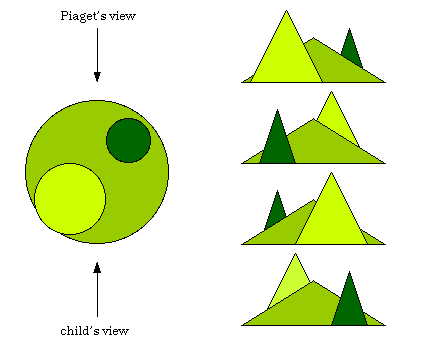
Before we proceed further, it is instructive to distinguish between perceptual perspective-taking or point-of-views as outlined by Piaget and more emotional-cognitive theory-of-mind perspectives as elaborated by Selman. The 'impersonal' point-of-view tasks that piaget used (for eg in the famous point-of-view task whereby a Christmas tree was obstructed from point of view by hills. See figure) rely more on whether one can literally see from the point of view of another person and is restricted to purely perceptual phenomenon. While egocentrism would correspond to undifferentiated perspective taking (stage 1) of Selman as it involves inability to distinguish one's own perspective from those of others, Decntering would be akin to taking third party perspectives (stage 4) of Selman. Piaget's decentration may be a necessary (but not sufficient say in the case of people with Autism) condition for the development of third-party perspectives stage of Selman.

Thus, in the ensuing discussion all references to perspective-taking would be in the theory-of-mind emotional-cognitive sense and not in purely perceptual terms.
Consider as an example a story presented to children who are then asked on what the protagonist would do and how others would react to it.

Holly is an 8-year old girl who likes to climb trees. She is the best tree climber in the neighborhood. One day while climbing a tree she falls off the bottom branch but does not hurt herself. Her father sees her fall, and is upset. He asks her to promise not to climb trees anymore, and Holly promises.

Later that day, Holly and her friends meet Sean. Sean's kitten is caught up in a tree and cannot get down. Something has to be done right away or the kitten may fall. Holly is the only one who climbs trees well enough to reach the kitten and get it down, but she remembers her promise to her father

The first stage of Selman is based on Undifferentiated Perspective whereby one attributes one's or protagonist perspective to everyone else's. One may have a concept of perspective or Theory-of-mind but may suffer from an inability to attribute any other perspective to anyone else distinct from one's own. Thus typical response are like "The child predicts that Holly will save the kitten because she does not want it to get hurt and believes that Holly's father will feel just as she does about her climbing the tree: "Happy, he likes kittens"

This also relates to Kohlberg stage 1 in the sense that one comes to realize that one can have a 'moral' perspective on a subject. This 'moral' perspective though is undifferentiated from what the society has imposed in the form of rewards/ punishments . One confuses others moral perspective (father says this is right" with ones own "this is right" and sort of has an undifferentiated moral sense. Everyone should behave like this.

The second stage of Selman is the social-informational perspective whereby one comes to realize that not only there exits a perspective, but that it can be different for different persons. Nevertheless, despite the realization that the perspectives can differ ( based on say the different information that each may have) the preponderant tendency is to consider one's perspective as valid and by exchanging information attempts to make others perspective inline with one's own. Thus a typical response may be " When asked how Holly's father will react when he finds out that she climbed the tree, the child responds, "If he didn't know anything about the kitten, he would be angry. But if Holly shows him the kitten, he might change his mind." The attitude is typical of a person who realizes that someone may have a different perspective, but that perspective is not valid and is due to lack of information.

This too relates to Kohlberg's second stage which is marked by self-interest and deal-making . One realizes that people may view things from different 'moral' perspectives, but also there is a preponderant tendency to favor one's own moral perspective (that is based on self-interest) over others moral or ethical perspective. Thus there is relativism, but a relativism that is skewed by self-interest. Also exchanging or del-making as a way to align self-interest or different moral /ethical perspectives is the norm.

The third stage of Selman is marked by self-reflective perspective taking which marks the first empathetic perspective taking whereby one sees, thinks and feels from other person's perspectives using first person. This is literally stepping in someone else's shoes and truly seeing as if the situation concerned oneself. This not just a logical realization that someone can have a different perspective but also realizing that that perspective can be equally valid given the other person's unique situation. Thus one thinks and feels like the other person and can both suffer and enjoy the outcomes of situations as they unfold from the other person's perspective. The emphasis is on understanding. And empathy. Thus the typical responses like " When asked whether Holly thinks she will be punished, the child says, "No. Holly knows that her father will understand why she climbed the tree." This response assumes that Holly's point of view is influenced by her father being able to "step in her shoes" and understand why she saved the kitten. "

This too relates well with Kohlberg's third stage marked by interpersonal relations. When one has developed empathy and understanding, one is guided by ensuring that the dealings are ethical in the sense that they make people feel good , enable one to be viewed favorably by others (realized as a good and genuine person) and generally lead to good relations. Empathy and understanding leads to valuation of individuals as similar to oneself and thus equally valuable. All moral/ethical conduct is guided by the dictum of good outcomes and relations between all (and especially those closely empathized with) parties concerned.

The fourth stage of selman becomes possible by the appearance of third-party or 'bystander' perspectives whereby one has decentred in the emotional/cognitive personal sense and can see a situation not only from first and second person perspectives of interacting parties, but also from that of a neutral bystander. This includes the ability to keep multiple perspectives in mind at the same time. One does not see from this perspective and then from the other - one looks at the entire big picture or view and understands that different people are having different perspectives. Thus typical responses include " When asked whether Holly should be punished, the child says, "No, because Holly thought it was important to save the kitten. But she also knows that her father told her not to climb the tree. So she'd only think she shouldn't be punished if she could get her father to understand why she had to climb the tree." This response steps outside the immediate situation to view both Holly's and her father's perspectives simultaneously. "

This also relates closely to the Kohlberg's fourth stage marked by conventional focus on social order. The ability to keep multiple 'moral' perspectives in mind at the same time and the ability to abstract and construct a big picture from these perspectives enables one to come up with the concept of the social morality, or morality that is not governed by different moral perspectives of the participating actors, but is based on the effects these acting persons have on the big picture, the social fabric. Thus the criteria of any ethical actions is adjudged as to how it influences the social fabric - does it lead to maintenance of social order- the third party neutral moral playground and its rules - or is it subversive to it. This is as opposed to the earlier ethical thought and action based on interpersonal focus on individual's morality. The stage now becomes more important than the actors.

The fifth stage of Selman derives form maturation of this to a societal perspective, whereby one realizes that the neutral third party perspective is not really neutral but influenced by the societal and cultural context in which the bystander lives and is reflective of those values. One realizes that one can have different neutral perspectives on a situation, each of which would be colored by the values that are dear to the social and cultural context in which the situation occurs and which dictate what a neutral perspective is. One may realize that some values are desirable and others are not and that the perspective that is informed by desirable values is more preferable. The typical response thus are "When asked if Holly should be punished, the individual responds, "No. The value of humane treatment of animals justifies Holly's action. Her father's appreciation of this value will lead him not to punish her."


This too corresponds well with Kohlberg's fifth stage with the emphasis on Social Contracts and individual rights. When one realizes that the neutral third party perspectives cannot be neutral with respect to the fundamental values and human (or cat in our example) rights that inform such perspectives, then one realizes that while one has societal duties in the form of maintaining the social order which allows for resolution of conflicts between individual moral perspectives, one also has a duty to ensure that the societal laws, mores, traditions are such that they upheld this rules and regulations that are best suited to the human condition. One not only has duties, one also has rights that one can expect from the social fabric. Here one may play with different social values before coming up with a set of values that one deems are amenable to making most interactions viewable from a neutral perspective. One discovers one's moral self and takes activism other measures to ensure that ones moral sense is inline with external social fabric in which one lives.

There is an interesting twist to the whole thing. It seems that moving to higher perspective stages involves taking in more and more information to form ones perspective. This bodes well for the information age. As more and more information becomes available at our fingertips, and we realize novel methods of integrating that information to form better perspectives, our moral sense and actions should also continue to be on upswing.

Selman himself has compared his work to Kohlberg's stages. I don't have access to the article, but others may find it interesting.

More later on the qualitatively different 6, 7, 8 stages. (which I'll have to work out from thin air!)

Sphere: Related Content

Monday, August 21, 2006

Synapse vol 1, issue 5 now online

Synapse vol 1, issue 5 is now online at the Retrospectacle.

This issue of the Synapse features interviews; introductory descriptions of topics as varied as eye movements and sleep disorders; cutting edge news on developments like HAR1's light-to-prominence; detailed analysis of niches like bird songs and circadian rhythms and much more. Go to the Retrospectacle to catch on.

There is also an article on Childhood Poverty and Neurocognitive Development and this takes forward the debate on effect of socio-economic status on IQ and cognitive abilities that have been earlier mused on by me earlier on the mouse trap.

As usual, a post from this blog features in the Carnival.

The Next synapse, i.e. Synapse Vol 1 Issue 6 would be hosted right here at The Mouse Trap on September 3, 2006. So don't forget to drop in then and also drop in your submissions for that edition in the meanwhile. Submission guidelines are right here. Deadline for submissions - one minute before midnight, September 2,2006!

Sphere: Related Content