Saturday, August 19, 2006

A glimpse of my Memome!

Ok, I have taken the gauntlet and decided to expose 5 of the memes that make my Memome.

This post is courtesy Retrospectacle.
>>

The rules: "Go here and look through random quotes until you find 5 that you think reflect who you are or what you believe."
>>
  • They always say time changes things, but you actually have to change them yourself.

Andy Warhol (1928 - 1987), The Philosophy of Andy Warhol

  • You can't turn back the clock. But you can wind it up again.
Bonnie Prudden

  • Our greatest pretenses are built up not to hide the evil and the ugly in us, but our emptiness. The hardest thing to hide is something that is not there.
Eric Hoffer (1902 - 1983)

  • When a man is wrapped up in himself, he makes a pretty small package.
John Ruskin (1819 - 1900)

  • The art of art, the glory of expression and the sunshine of the light of letters, is simplicity.
Walt Whitman (1819 - 1892)
OK these were 5 of my memes. Now its your turn. Truth or Dare!

Sphere: Related Content

Moral dilemmas and what they tell us about moral development

There is an interesting article on Rationality Vs. Emotivity influence in moral decisions and a commentary on the same by Thinking Meat.

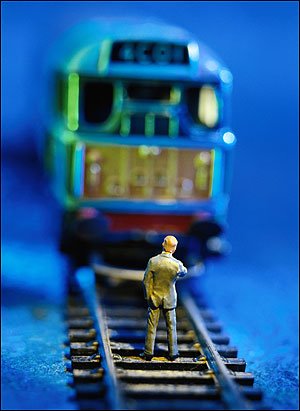
As per that article, different decisions are reached in a situation that mandates one to choose a life of one person vis-a-vis that of 5-6 other people, depending on how the situation and moral action to be taken is presented. The hypothetical situation is that of a train/trolley running on a track and 5-6 people unaware of the impending train on the tracks ahead.

In one version of the situation, you can press a lever to divert the train to another track, on which only one person is present, and thus save 5-6 lives by compromising on one life. Most people, when the situation is presented thus, opt for the option of pressing the lever.

In the second version, you can push another person on the track, so that his impact will slow the train down and thus lead to saving of the other 5-6 people down the track. In this situation people usually choose not to throw the person on the track. Also experiments have revealed that emotional centers of the brain are engaged while making this decision.

While some theorizing is going on that the (imagined) action of pushing is not preferred due to the emotional reality of touching and pushing someone to end his life and that this particular (imagined) feeling leads to the decision not to throw the person on the track, let us focus more on the rational or deliberative part of the decision making.

It would be instructive to get familiar with Kohlberg's excellent Moral Development Stage theory for further discussion.

From the point of consequences , the two situations are the same. One life vs many lives and the choice lying with the user (you). Also, perhaps equal societal punishment or recognition based on your choice. Thus, any Moral reasoning employing piaget's first stage or Kohlberg's first stage focusing on reasoning on the basis of consequences or societal punishment/rewards does not solve the dilemma as to why one would act differently in two situations. In both situations, one may be guided by a 'rule' or social dictum like that 'many lives are better than one live'.

From the point of self-interest and relativity(Kohlebrgs second stage), the dilemma doesn't make sense as neither the one person that needs to be sacrificed nor the many other that will be saved are either you or related to you. So the dilemma doesn't solve for a person on second stage. In both cases he should make the same choice based on self interest and that choice may be not making a choice (neither pushing the person, nor pressing the lever) and thus being saved of any consequences that result from the making of choice.

From the point of Conventional morality employing good interpersonal stage of reasoning (stage 3 of kohlberg) the question would now become rephrased as what a 'good' person would do. Also, in absence of information about whether the one person about to be sacrifice is 'good' or the 5-6 to be saved are 'evil' and should not be saved or vice versa, he has no rational basis to make decisions. The one factor that may influence his decision is the proximity of pushing a person down, which may not fit in with the self-perception as a good person and this may explain to a certain extent the skew towards not pushing a person to save lives of others. In this stage of thinking pushing a lever and pushing a person may have different connotations.

From the perspective of social order (stage four), this dilemma presents a challenge. Before deciding which way to act, one would need to deliberate on whether the social order demands that one life be sacrificed to save many more, whether one need to take life of someone to prevent deaths of many others (this can be framed as should a dangerous murder be sentenced to capital punishment) . Another deliberation can be what if all those whose life is at stake are innocent and differ only in the fact that sacrificing one innocent life early on can save many innocent lives later. This is the typical hostage scenario whereby you may have to release terrorists, in order to save an innocent life in the moment that is kept as hostage, only to discover later that this has resulted in many future deaths of victims of those terrorists. In such cases where one knows that one innocent life stands in balance for 5-6 innocent lives further downstream, one still has to make a decision and the consideration primarily is on what precedent it would set. How it affects social order. Would one start taking hostages often ? Thus, sacrificing one life may be the option chosen. These deliberations may lead to the insight that though it may be emotionally repelling one may need to push the person oneself in order to keep up the social tradition of saving maximum number of innocent lives.

From the point of Social Contract and Individual rights (the fifth stage), it may seem that the life of every single individual is very valuable and maybe equally valuable. One may gain insights as to the fact that no amount of property is as precious as even a single (human) life. If this dilemma involved a choice to blow the (goods) train that was carrying vast amounts of wealth in order to save all the lives involved, then one may choose that. As the question is currently framed, there is not much ground on which to decide whether to sacrifice one person or many others. One may deliberate on the greatest good for greatest number of people and thus chose to sacrifice one person, so that many others can see much more years. Again, one may take into account the fact that the one person to be sacrificed is child ( and has many more years of life) and thus needs to be saved in contrast to 5-6 people who are old ( and thus wont see much life). One may even employ the reverse analogy and see that one old man (who has vast amount of wisdom) needs to be saved as he is of greater use to humanity then a child in which one has not invested much. All these deliberations involve and individualistic regards as to the value of life and value of unrealized potential or accumulated experience. What is important is the reasoning involved.

I wont go to stage 6 (universal principles) as Kohlberg himself has sort of retracted the sixth stage, but would hint that from that stage the dilemma gets interesting with discussion of life as a means or life as an end coming into picture. This is mentioned in the original Boston Globe article and is what Hauser is elaborating on. As per Hauser, one may be utilizing a universal moral principle (like universal grammar of language) preceding any rational or emotive deliberation to resolve such conundrums. In this universal scheme Life as Ends may be more acceptable than life as Means. Framed this way given a choice between saving a child and saving an old man, one would always choose a baby (as he/she has more years of life (and end in itself) ) over the old person. Only when one treats Life as a means of achieving something (knowledge? ) one may value an old person over a baby.

But before concluding , I would like to link these stages of moral development with my own theories of 8-stage development.

The first stage is based on finding out rules of society and are authority based. The cognitive task is to find correct associations between behaviors and results (punishment/rewards) and find an accurate view of how the Reality out there is. A similar development process leads to attainment of Trust (knowing that rewards are in plenty) in child's development in Erikson theory. In moral development one develops capacity to link consequences to actions.

The second stage is based on seeing things from ones own point of view and is based on self-interest. One realizes points of view of others , but does not empathizes and is more of a deal making attitude. The cognitive task is to choose for oneself what would benefit one the most. In eriksons framework this leads to Autonomy (will) whereby one can decide for oneself. In Moral Development this takes the form of graduating from society's dictums to a relativist position whereby one can choose what is beneficial to oneself in the moral sense (that is what fits one's morality). One develops the capacity to choose over different options/ viewpoints.

The third stage is based on focusing on how the moral decisions is governed by interpersonal relationships. Here concepts like 'goodness' , empathy, motives become important. One starts thinking in terms of effects ones actions have on others and vice versa. This cause-and-effect interactionist view that goodness is an end in itself and that what goes around come back governs many of the moral decisions. The Cognitive task is to understand and appreciate the effects of one's actions on others. In erikson's framework this takes the form of Initiative or Purpose whereby one tries to co-operate with others and either lead or follow to accomplish goals. In Moral Development this takes the form of realizing that one has the capacity to do good and one should use that capacity.

The Fourth stage is based on focusing on maintaining the social order. One again gets obsessed with societal laws and more, but now does not see them as rules to be followed, but norms which the society has and which are for the good of the society. Thus, these 'good' norms are internalized and ones moral thinking behavior geared around maintaining the norms so that society can function as a whole optimally. The concept of Social duty forms and one feels obliged to return to society what one gets from it. The Cognitive task involved are to understand that one is part of a bigger society, to understand the complexities involved in social interactions and to learn the fragility of social fabric and the need to preserve it as the social fabric is responsible for the large amount of learning that individual suffers by indirect means like observational learning. In Erkison's stages one develops Industry or a sense of competence that they can also work as effective members of a social group. They learn to follow rules followed by their peers or self-imposed by themselves as part of games etc. In the Moral Development this takes the form of realization that one has some moral duties towards the society in which one lives.

The Fifth stage is characterized by focus on Social Contract and individual rights. On makes moral decisions based on the fact that one has voluntarily negotiated a social contract with others on ones' own terms that have included a strong focus on enjoying some rights as part of that social contract. Here, Kohlbergs notion of roles may be appropriate. One plays with different roles (as a moral agent) that one has to play while living in a society and instead of playing the role that his society may demand, turns the tables around and says that I as an individual be;live in these moral rights and duties and that this is my limited social contract with the society. In a sense one has defined one's role and negotiated a personal contract based on that role and feels that neither the individual nor the society-at-large is under any other moral obligations. The cognitive tasks involved are gaining insights into what moral action or thought that one believes in are and how one can consistently use those moral rules while living in a society. The discovery of a moral self is the culmination of these 5 stages of moral development. As an outcome one may end with a rigorous personalized set of moral rules. In Eriksons theory this is equivalent to the similar (ego)Identity achievement of a n adolescent whereby one plays with many roles before deciding on one that one plans to stick around with. In Moral Development this is akin to forming a strong, personal moral sense (self) vis-avis not having a particularly integral sense of having a personal moral sense / conscience.

It's interesting to draw parallels here with my earlier posts on Cognitive Maps whereby in stages 6, 7, 8, if the development is not proper one may regress to earlier stages and suffer from pathologies like regression, fixation or displacement to out groups. I propose that if after achieving a moral self if one does not continue to develop along quantitatively different next three moral stages, one may regress to earlier dysfunctional moral stage when faced with stress situations.

What these 6, 7 and 8 stages of moral development are? Wait for the next mail!! A tantalizing hint that 5th stage may involve another way of achieving moral-ego-integrity (more akin to how moral sense develops in females as per Gilligan) and the 6th stage may involve literally stepping in someone's else's shoes as if you are that person and then resolving a conundrum.

Sphere: Related Content

Friday, August 18, 2006

Predicting the future and the Phillip K Dick association

There is a post at Mind Hacks on Phillip K Dicks and how he makes use of psychology in his novels. That post made me curious as to who Philip K Dick was and to my surprise I discovered that many of my most-liked movies like Paycheck and Minority Report are based on his writings. Also that some movies on my hitlist like Blade Runner are also based on his novels. Amazing indeed and I hope to read some original works of Philip K dick soon. Would like to find out if the readers of this blog too find his more-or-less gripping account of predicting the future in Minority Report and Paycheck enticing.

Sphere: Related Content

Unification of psychology in either direction


There is an interesting endeavor going on at PsyBlog to document the unity of psychology journey and current issues.

I got hooked to the same as I am also currently reading Consillience by E. O. Wilson and thus on the lookout for unified theories. Thanks to Mind Hacks via which I discovered this thread.

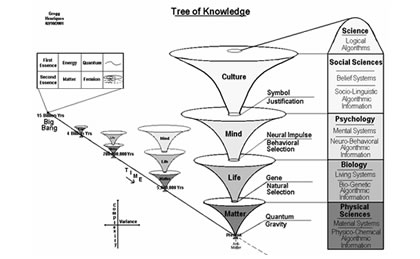
As per the Tree of Knowledge of Henriques, Psychology (on the mind plane) sits between Biology (on the life plane) and social Sciences (on the culture plane). He bridges the efforts of Skinner (towards the biological end of the spectrum) with Freud (towards the sociological end) as under the umbrella of psychological domain.

What interests me, is my own obsession at the two ends of the spectrum. While the Cognitive Map and research of Tolman seems to me a marking phase in psychology where behaviorism led way to the more cognitive approaches belonging to psychology proper; I am also intrigued by Conceptual Metaphors and linguistics which sits at the intersection of psychological phenomenon like thoughts and cultural phenomenon like language and its effects (the sapir-whorf hypothesis).

Hopefully my idiosyncratic tastes in Psychology would help the readers onwards on their own journey of unifying the Psychological stream of inquiry.

Sphere: Related Content

Now I see it, now I don't : object and motion permanence

Cognitive Daily has a good article summarizing the findings of recent study on 4 month old babies and how they perceive moving objects.

The study utilizes the fact that babies look longer at stimuli that are interesting or what they perceive as novel. The results of the study indicate that if a moving ball is occluded by a stationary object, then the motion prior to occlusion and posterior to occlusions would be perceived as the same motion if the time of occlusion or length of occlusion is small.

This is an interesting finding from two angles. First this study necessitates that one distinguish between object permanence and motion permanence. The former seems to be an easy to achieve property relying only on the static stimuli and should be judged only by the fact as to whether a child gropes for an object that has now been occluded and is out of sight. The latter, viz. motion permanence implicitly assumes that object permanence has been achieved. It doesn't make sense to say that two motions that were temporally or spatially close are the same if the object undergoing that motion was not existent even when occluded.

Thus, these experiments provide further evidence that Piaget had misjudged the capacity of babies to achieve object permanence.

Endgame: does the existence of two visual pathways : one specialized for motion perception and other for location/shape/color/object mean that object permanence and motion permanence may be achieved at different ages and may have different underlying prognosis?

Sphere: Related Content

Wednesday, August 16, 2006

Encephalon #4 is online now!

The fourth edition of Encephalon is now available at the Neurocritic.

The articles range from speculation as to how the mapping of Neanderthal genome can give clues to human brain evolution to how Magnocellular pathway used for Motion processing may be more prone to neural plasticity and may be differentially affected in conditions like autism, dyslexia or deafness.

The other focus of the carnival seems to be (debunking of) lie-detection techniques and also biochemical focus on classification of stimulants/ psychedelic and how to dope test the athletes based on chemical properties.

Two articles form this blog also featured.

Have a nice read.

Sphere: Related Content

Friday, August 11, 2006

A pitch for vegetarianism

There is an interesting post on Brain Wave related to country-wide differences in conditions that lead to higher level of oxytocin /estrogen and how these levels of oxytocin are correlated to the level of trust.

As per the study, some factors like the consumption of healthy food consisting of vegetables and fruits, and other factors like clean environments are directly related to average levels of Oxytocin in the population. Also, the same factors are shown to be correlated to levels of trust in the population. It is instructive to note here, that Oxytocin mediated Tend-and -Befriend response to stressful situations has been posited in females as opposed to fight-or-flight (male) response.

What is even better is that Trust and happiness are found to be correlated. Moreover, greater levels of trust are correlated with better economic environment. Thus, a sure way for a country to become both prosperous and happy is to focus on factors that raise the national Oxytocin levels - HUGS and fresh vegetables and foods!

Sphere: Related Content

Thursday, August 10, 2006

Conceptual Metaphor Theory: The ship for all seasons

There are some articles online by Lakoff, that pertain to the Conceptual Metaphor theory and are a must read for anyone intrigued by that figure of speech called Metaphor. For a layman, Metaphor is when a literal reading of a sentence/phrase has to be abandoned and the utterance understood 'figuratively'. This definition may be more appropriate to the Novel metaphors / image metaphors that rely more on conjuring up image-schemas to make sense. The 'figure of speech' or 'figurative speech' descriptions may themselves be part of the conventional metaphor "LANGUAGE IS DEPICTION" and are explained by mappings between language: an abstract target domain being mapped to a more concrete source domain of (cave art) symbolic depictions/illustrations. While some concepts would be represented by symbols in the source domain of art representation, others would be not be representational, but based on form of figure would be equivalent to actual physical objects (hieroglyphics). Thus, the very definition of (novel) metaphor is grounded in Conceptual metaphor theory.


Lets us start with an example of metaphorical mapping given by Lakoff: " LOVE IS A JOURNEY" with the metaphorical mapping deconstructed as (emphasis mine)

-The lovers correspond to travelers.
-The love relationship corresponds to the vehicle.
-The lovers' common goals correspond to their common destinations on the journey.
-Difficulties in the relationship correspond to impediments to travel.
Although I would have preferred to frame the "LOVE IS A JOURNEY" AS "LOVE IS A VOYAGE (OF DISCOVERY)" so as to remove the burden of having a well defined destination as a goal for the journey by a relatively carefree discovery (about each other) as the destination/goal of Love, yet, in keeping with the "LOVE IS JOURNEY" metaphor it is instructive to note that the VEHICLE (of source domain) is mapped to relationship (of target domain) and the word relationship contains "ship" a popular vehicle for traversing difficult terrains like the sea. More interestingly, many similar associated words like friendship, courtship, companionship too have the word 'ship' embedded in them.

To elaborate, while "relationship" to "vehicle" mapping is present in the "LOVE IS JOURNEY" metaphor, the mapping is of superordinates in the sense that the "VEHICLE" itself is abstract and can be a ship, a car, a boat; also while Lakoff doesn't mention this, the relationship can be substituted by companionship/ friendship in case of some other related metaphors like "FRIENDSHIP IS A JOURNEY". What Lakoff does discuss is some sort of inheritance hierarchy whereby the structure of a base metaphorical mapping like "PURPOSIVE LIFE IS A JOURNEY" is inherited by a derived metaphors like "LOVE (LIFE OF TWO) IS A JOURNEY" or "CAREER (upward purposive) IS A JOURNEY".

To have more clarity on the 'conceptual' part of the conceptual metaphor theory consider metaphors that we normally use for some concepts like time (already discussed earlier in one of the posts), quantity, quality, category etc.

The first of these semantic concepts is "CLASSICAL CATEGORIES ARE CONTAINERS" metaphor. Here, an item (object) can be either 'in' a category (container) or outside of that category( container). Of course a third possibility exists that the item "is and is not" in that category(is on the surface of the container), but this is not discussed by Lakoff.

The other mappings like "QUANTITY" of an object is spatial direction "UP" is based on the 3-D internal representation of Cartesian space and relies on our commonsense concrete observations like a pile grows in upward direction when more quantity is added, or that a fluid in a container rises up when more liquid is poured in. Thus we have statements like 'the crime graph soared up while the economy dwindled.'

The "QUALITY" of an object (or linear scales measuring it) is a "PATH" metaphor, again uses the underlying structure of path whereby the movement is in front direction (possibly radial direction) direction and is based on the fact that distance in the radial direction is equivalent to more or less of a quality. Thus, statements like 'in terms of Intelligence he is way ahead of you'. It is interesting to note that PATH metaphors rely on angular geometry concept (with the travelers or subjective origin) always present implicitly in the metaphor.

Another interesting metaphor is the underlying structure mapping time. Hereby, "TIME IS MOTION" (OF AN OBJECT/ OF A SUBJECT THOROUGH A LANDSCAPE).

Of the first of these dual Time metaphors exhibiting duality of object/landscape, time is motion of object assumes that Future Time is (someone/thing personified) coming towards us and past time is receding from us. This leads to expressions like The time will come when... The time has long since gone when ... The time for action has arrived. That time is here. In the weeks following next Tuesday.... On the preceding day, ... I'm looking ahead to Christmas. Thanksgiving is coming up on us. Let's put all that behind us. I can't face the future. Time is flying by. The time has passed when etc

It is instructive to note that Aymara have a reverse metaphor , whereby their backs are towards future. Logically this makes more sense as FUTURE is not visible to us (unless we have good predictive powers ) and so should come from behind us and surprise us, while past is there for us to see till eternity and should be in front of us. Anyway, this metaphor representation too represents the TIME as linear motion. What is more interesting concept is that of time as circular (and thus periodic/ rhythmic) Motion. The interesting metaphor here would be standing close to a merry go round and watching events flow past oneself. Here too differences can arise based on whether one is watching things in counter-clockwise motion or clockwise motion. Interesting to note that many concepts related t time are circular(spherical/ rhythmic) in nature and even concepts of clockwise rely on concept of clock/time.

The other metaphor for time is TIME AS MOTION OVER A LANDSCAPE. This I believe is no different from first one,except in the sense that it relies more heavily on "NO MOTION" . Thus when the passage of time does not lead to any noticeable changes (CHANGE IS MOTION), then one may be apt to treat the time as a location. The examples given corroborate this.
  • He stayed there for ten years.
  • He stayed there a long time.
  • His stay in Russia extended over many years.
  • He passed the time happily.
  • I'll be there in a minute.
Even the last example illustrates that not much will happen in the 'minute' and thus minute is exemplified as a location/container.

A very important metaphorical mapping discussed is of EVENT structure.
The EVENT domain is mapped to basic concrete domains of space, motion and forces.
Here,
  1. States are locations (bounded regions in space).
  2. Changes are movements (into or out of bounded regions).
  3. Causes are forces.
  4. Actions are self-propelled movements.
  5. Purposes are destinations.
  6. Means are paths (to destinations).
  7. Difficulties are impediments to motion.
  8. Expected progress is a travel schedule; a schedule is a virtual traveler, who reaches pre-arranged destinations at pre-arranged times.
  9. External events are large, moving objects.
  10. Long term, purposeful activities are journeys
I would like to distribute this in my 8-fold path with the first five of these describe the event in terms of the entities involved. The next 3 in terms of the context or environment in which the event happens.

  1. States are confinements of space.
  2. Changes are movements
  3. Causes attributed are underlying forces amongst the objects/ force field.
  4. Outward Observable Actions are equivalent to self-propelled motion with no observable external cause
  5. Purpose or reason for the event is mapped to there being destinations or goals.
  6. Means used to achieve the event-happening is mapped to there being paths (multiple) for the purported destination and choosing of one path over others.
  7. There are 3 factors affecting outcome when one means(path) is chosen- difficulties mapped to impediments to motion in the path; subjective assessment of progress mapped to scheduled milestones in the path; and unpredictable and outside control other (synchronous) events mapped to external large moving bodies ( that may curve the time space). It also interesting to note that large , moving objects are conceptualized in terms of Things, Fluids and Horses ( in the last of which balance is required to control the motion).
  8. Finally, The events that are meaningful (have purpose and right means etc) and are extended are equated to Journeys or voyages though time-space.
Lakoff also maps this event structure to duality of object-location whereby events may be attributes possessed or happening in a location (space time). Thus, one can either be 'in trouble' or 'have trouble'. In the former case one is conceptualizing the event (trouble) as being confinement in some space-time that is associated with trouble. In the latter, one is conceptualizing trouble as a possession or attribute that one has.
In my view the right framing is one that uses location metaphors as that is more related to paths, journeys etc. rather than object metaphors which necessarily signify events (even related to other persons) as objects of gratification.

While time is sometimes personified while doing CMT, another interesting case is that of DEATH usually personified as a drivers etc. This bodes well with other metaphors like BODY being a VEHICLE/CONTAINER for traversing this sea of life and transcending to other other end. The death personified serves as a driver taking one from life domain to the other transcendental domain. No surprise in MATRIX revolutions, Sati meets NEO while the DEATH driver for the train is coming to take NEO to the underworld (of death).

Before closing would like to add a few notes on poetical metaphor or Novel metaphor (which will deserve their own posting). I believe they involve conjuring of actual images in the mind to work and are slightly different from conventional metaphor. They may in time become entrenched and lead to conventional metaphor.

Before closing I would like to point to one previous post on this blog, whereby just like " NATION is A SHIP" metaphor , I compare a COMPANY to a RIVER-RAFT.
Also , In my earlier poems I have been heavily using metaphors like COURTSHIP is LIKE FISHING and GROUP OF FRIENDS IS like a SHIP.

Finally, here is a list of some common metaphors outlined by Lakoff.

Sphere: Related Content