Wednesday, July 26, 2006

Parapsychology: The alien hand syndrome, Ardhnarishwar and the epileptic (dis)connection

There is a post by NeuroPhilosopher regarding Parapsychology (psi phenomena) and their plausible explanations. It is an excellent summary of some of the usual suspects and how they can be explained.

I am intrigued by the fact that almost all explanations (except possibly those involving Magical thinking) seem to be one-way or the other related to temporal lobe stimulation/epilepsy and differential processing of information by the two hemispheres.

To quote,

>>

All psi phenomena include a blurring of the distinction between perception
and imagination; many involve reports of a sensed presence and distortions in
the perception of time.

>>

Further,

>>
It is well documented that patients with temporal lobe epilepsy often report having paranormal or religious experiences. In fact, both kinds of experiences can be evoked experimentally by magnetic stimulation of the tempero-parietal region. These regions, which are involved in awareness of the 'self', trigger the experience of a sensed presence when stimulated.

>>

Interesting to note, that temporal region is implicated in time perception and most psi phenomena, as noted, involve distortions in time-perception.

Further on, in the blog-post, it is speculated that 'Automatic writing' may be attributable to phenomenon like Somatoparaphrenia, which involve attribution of paralyzed left hand (in case of right brain stroke) as belonging to spouse/doctor. Though the facilitated communication case, in which one alleges that the hand is not controlled by oneself, is qualitatively different from the paralyzed hand belonging to spouse/doctor, the two may share the same mechanism with the pathological case being a permanent manifestation vis-a-vis the temporary possession of hand during automatic writing. It is intriguing to note, that in the Hindu culture, spouse is believed to be the owner of the left side of one's body and even one of the gods is Ardhnarishwer : or half-male-half-female. Also, in Hindu rituals, the spouse (wife) normally sits
on left side during auspicious occasions.

If one refers to the basic developmental schema that I believe in and advocate: viz 5 + 3 = 8 stage development; then once the brain has differentiated into 2 halves (the right and left hemispheres ) then to enhance its cognitive maps it may allocate one hemisphere to see the cognitive map in one 'spin' direction; while allowing the other hemisphere to see the map from another 'spin' direction (possibly the 'spin' direction utilized by the spouse/partner.

We already know that left/right asymmetries do exist for many factors like abstract via-vis concrete etc. So if the right brain is associated with spouse (which seems logical as we can only perceive from spouse's viewpoint abstractly and not in the concrete details that are available to our-selves ...and thus the right brain would be the place from which to view the cognitive map in a black-box abstract view, while utilizing left hemisphere for concrete self perceptions), then a stroke in that region may cause the left brain which is used to process inputs from the right-as that from the spouse's viewpoint) to assume that the body regions governed by the right actually belong to the spouse. In the normal, no-stroke, condition, signal processing in right brain may nullify this effect.

Further on, it is speculated, that Ouja boards may be due to the alien hand syndrome (normally evident in people who have a partial disconnection of the anterior corpus callosum, the bundle of one hundred milliofiberses connecting the two hemispheres of the brain). In this case, maybe the mechanism implicated is the seventh stage of brain evolution, wherein group effects come
into prominence. To elaborate, when feedback between the 2 hemispheres is not proper, then in a group situation of an ouja board, it may appear to the left brain (that may be involved in self consciousness more heavily), that the left hand is actually controlled by the group and by not the person individually.

This may explain why ouja boards need a group situation and if this is true then left hand should be more heavily used in such procedure involving 'collective unconscious'.

Finally, it is argued that alien-hand-syndrome is also exhibited in split-brain patients (who have been subject to commissurotomies to protect them from life-threatening and incurable temporal lobe epilepsies.) Again, severing the feedback from the hemispheres to each other, can lead to effects related to the eighth stage of brain developmental tasks viz: transcedence and integrity. Here, the split-brain may not feel integrated and thus refuse ownership of some of the body parts it controls.

Roger Sperry and Gazzaniga experiments on the split-brain patients are very instructive. In one experiment with split brain patients, the left hand handles some object behind a screen ( and the sensory information required to recognize the object is available to the right brain) and they are shown some keywords to the right eye (and thus these words are available to the left brain) and when asked to choose a keyword, the patient would choose a keyword that was related to the object that was being handled by the left hand. For example, if the left hand was handling an injection, then the right eye (and the person as a whole would choose nurse for the list of keywords . (The actual experiment I just remembered was a bit reverse to that...in it an object related to keywords shown was picked up...but this distinction does not affect our discussion) . When the split-brain patients were asked to describe why they chose the particular keyword (or object), they would come up with all sort of valid narratives and confabulations and rationalizations.

These experiments demonstrate that we compose elaborate narratives to explain something (choices we have made) that has been the result of unconscious processing, but have resulted in conscious behavior. Thus, many psi phenomenon, that seem inexplicable today, may be due to us gathering some unconscious inference, but as the information or the method of acquiring that information, is not readily available to consciousness, we indulge in magical thinking. We are able to correlate things, but the science is not adequate enough (in terms of being in the purview of consciousness realm) and thus we cannot decisively draw a scientific causal relation.

Thus, while Neurphilosopher came to the conclusion that more light on psi phenomena will be thrown as we get to know more about consciousness, I believe our understanding of unconscious processes would also be very relevant here.

Sphere: Related Content

Tuesday, July 25, 2006

Drug usage likelihood and Cognitive Dissonance

Cognitive Dissonance (as per say Aronson instead of say the original Festinger definition) is a phenomenon whereby if one indulges in a behavior that is not inline with one's normal schema about oneself, then the discrepancy between the actual behavior and one's own self-perception leads to a dissonance (or state of unrest/anxiety), such that one modifies one's internal schema/ self-perception to make it inline with outwardly exhibited behavior. The classical case is a celebrity (who normally smokes) endorsing a public commercial for 'no smoking'. Just after publicly asking others not to smoke, the celebrity would feel a Cognitive Dissonance and to reduce that uneasy feeling may decide to change his/her self-image to be that of non-smoker and this may lead to him/her smoking less in future. If the incentive to indulge in the hypocritical behavior was less (say the endorsement of commercial was for free and the celebrity did not take an excessive amount of money to endorse the ad, then this would lead to more dissonance and vice versa.

There is an article on BPS related to an observation that drug usage likelihood increases subsequently if people are asked about drug usage likelihood earlier
This study leads to several questions.

How does this observation relate to Cognitive Dissonance effect? When the respondents were asked about likelihood of drug usage and (supposedly) they replied in the negative (to please the surveyor), then this small incentive to lie should have ideally led to a large Cognitive Dissonance and prompted them to stop using drugs and led to change in drug-usage behavior to overcome the dissonance experienced. Is some data available as to whether those who reported more drug usage later had replied in affirmative or in negative to the earlier drug-use-likelihood question? Is there a priming effect so strong that it is shadowing the cognitive dissonance effect? This study raises more questions than it answers!

Sphere: Related Content

Intuition / "Blink"

There is an online article on intuition that focuses on amongst other things, how to increase your intuition and how to avoid the perils of wrong intuiting. Might be a good read for those who have been attracted by Malcom Gladwell's analysis of intuition in "Blink" .

Sphere: Related Content

Monday, July 24, 2006

Synapse #3 is up at the Nurophilosopher

The third edition of Synapse is up at the Neurophilosopher. It contains a witty article on mosquito songs, some other on Hypnosis and wakeful-yogic states , and some others on topics like the Mozart effect and neuron-Gila synapses. 2 posts from this blog, the mouse trap, are also included. Go ahead and have a good read.

Sphere: Related Content

Friday, July 21, 2006

4 (or more) cone vision : Tetrachromancy in Human Females vis-a-vis birds.

Cognitive Daily has a posting related to Human Female Tetrachromancy that refers to some old article on the subject. An interesting and must-read article on the web by Ryan Sutherland in detail explains the rationale as to how four cone receptors may arise due to X-chromosome related procedures. Also It is instructive to note here that if the additional cone that has shifted from Red(Long cone) towards green (the red-shifted) or from Green(The Medium cone) towards the red (green-shifted) has shifted to a considerable extent, then it may assume the role of phantom Yellow and thus lead to some radical re-wiring of the optical system in brain whereby Red(L) and Green(M) do not have to combine to give Yellow that can be considered along with output from Blue (S) cone to give rise to Blue-Yellow opponent process. In this case a simple consideration of output from Blue (S) and Shifted-red/shifted-green (Yellow) would give rise to the Blue-Yellow opponent process. I don't think such radical shifts are possible or would lead to such radical rewiring, but post-mortem analysis of Tetrachromat women may shed some light. Even if such a shift does occur , it may not lead to any change in the number of hues that could be distinguished, though the colors may appear more colorful and saturated.

Of further interest is the shift from red away from green side towards the ultraviolet. This shift may indeed give rise to ability to perceive Hues differently and to see some infra-red not normally visible to trichromatic humans.

coming back to different dimensions of vision, it is interesting to note that dogs (like most other mammals) have dichromatic vision and utilize the blue-yellow opponent process.

Cats utilize the same trichromatic color mechanisms as humans, but their total perceivable color range is sort of 'contracted' i.e. they don't see some of the human Red and some of the human Blue.

Bees have also trichromatic vision, but apparently their cones lie in UV, Blue and green. Thus they are unable to see human red but able to see beyond Violet (the UV). Maybe the genes coding blue lie on X chromosomes for Bees (instead of the red-green genes of humans and yellow of dogs) and its breakup into two (just like the breakup of mammalian yellow is hypothesized to have resulted in human Red-Green) has resulted in some infra-blue and Ultra-violet cones in the bees.

Further most birds (and some fish and turtles) have tetrachromatic vision with 4 cones : one in UV, one in Blue, one in green/yellow and the other in red. Thus, if humans do want to have a tetrachromatic vision a better way forward would be the split of blue cone in infra-blue and UV cones. That would really give us the capacity to for example view the human-white feathers of some birds as actually 'colored'/shining' in UV (as they reflect UV). For more details on comparative chromatic vision information please visit this excellent page on comparative chromatic vision. Also some evolutionary rationale for chromatic vision (and UV in particular) can be found here.

Endgame: Would introduction of a UV cone lead to radical changes in perception of the blue (blue-indigo-violet) end of the spectrum, just like splitting of Yellow into Red and Green led to totally new colors on the original Yellow part of the spectrum?

Sphere: Related Content

Encephalon second edition has been published

Pure Pedantry had published the Encephalon 2nd edition last Monday. The link to the second edition is here and I have been fortunate enough to be featured in that carnival. Couldn't post the link earlier as blogspot was blocked by Indian ISP for the major part of the week. I will be hosting an Encephalon edition sometime in December. Check out this blog later for details.

Sphere: Related Content

Thursday, July 13, 2006

The green dot illusion and Opponent Process Theory

Mind Hacks has an interesting article mentioning green-dot illusion. The Green Dot illusion is possible because of the opponent process theory of color perception.


As an aside, for an excellent account on Opponent process theory and how many observable normal and abnormal behaviors may be realized as gated dipole opponent processes please read an article by Grossberg on the same.

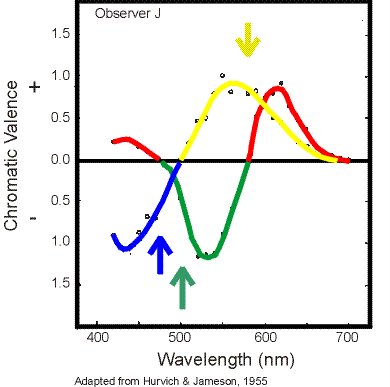
As per this theory, as applicable to color-processing (the herring theory), the higher level processing and perception of colors happens as an outcome of 3 opponent processes. Two of these are chromatic processes : one involving red and green opponent process and the other involving blue and yellow. One supposedly "achromatic" opponent process utilizing black and white 'colors' is also involved. Thus, while the Hue of any perceived color may be determined by the value of the red - green and blue - yellow opponent process; its Saturation (or the grayness or 'impurity') may be determined by adding the black-white opponent process value to determine the grayness of the stimuli while some other input (in the 'luminance' channel/ magnocellular channel of LGN) may be used for determining the Value or luminance or 'brightness' (refer HSV or HSL models of colors).

It is instructive to note that the red-green opponent process is realized by subtracting the output of Medium (green) cone from Long (red) cones and thus the R minus G signal should lead to either excitation of 'red color perception' and inhibition of 'green color perception" or vice versa. Thus, depending on the signal strength and polarity, later processing by neurons would happen as opponent processes, with 1) if red is being perceived then inhibit green-perception and vice versa. Also the blue-yellow opponent process is realized by first summing the Long (red) and Medium( green) cone outputs to create a yellow ( R+G) signal and then subtracting this from the Short (or Blue) cones to give a final B minus Y signal. Again depending on the strength of this signal, either 'blue color perception' is encouraged and 'yellow' color perception is discouraged or vice versa. When later the B minus Y and R minus G signals are analyzed (and possibly aggregated), one can determine the Hue of the color depending on the relative strength of the 2 signals.

An account of how all hues can be realized using this opponent processing is explained beautifully at this site and I also include a graph from that site for illustration of how all hues (in the humanly visible spectrum) can be realized using these opponent process. That said, there still remains the issue of perception of non-spectrum colors like purple, olive green , brown etc., these have been partly addressed in my earlier post on this matter.

To sum up, the moving green dot illusion works because red and green are opponent processes. When pink (which may be conceived as low-saturation red) dots are present in the visual field, then for that portion of visual filed, Red Qualia is exaggerated and Green Qualia inhibited further down the visual pathways. Prolonged presence of Red stimuli ensures that there is no need to keep inhibiting 'green qualia' as habituation happens and as the Red signal is strong and continuous one so the need to inhibit Green does not arise. If one refers to the gated dipole opponent process theory of Grossberg, then it is apparent that due to the gating of the dipole, when the RED stimuli disappears from the on-channel then the 'off channel' (corresponding to Green qualia) would result in a sudden rebound and thus momentarily the Green qualia would be perceived. Here it is instructive to note that the signal is R minus G i.e Red is the presence of signal and green the absence (or below threshold or negative signal). Thus the green dot illusion would become more stronger if pure red is used and a similar illusion can be produced by moving yellow dot when blue dots are involved.

Sphere: Related Content

Monday, July 10, 2006

V1 and imagination

Small Grey Matters has a post related to an experimental finding that there is an activation in V1- the striate cortex- when the subjects make motor responses to an earlier presented visual stimuli (this is the delayed response situation as in the post/ experiment). Also, this activation is not present in higher visual cortical areas and thus is a result of bottom-up processes. One speculation as to the presence of this activation about the same time as the motor response is that when making the response one needs to 'bring back to memory' or imagine the earlier presented stimuli (or the no-stimuli screen) and that bringing such image back to mind is necessary for the subjects to decide whether the stimuli was present or not.

Thus, a particular mechanism for explaining this activation could be that it is related to imagining the earlier-presented stimuli and is distinguished from the actual visual experience by lack of activation in higher visual areas. The 'imaginative center' of the brain may send inhibitory signals to the higher visual cortical areas so that this appears as imagination and not as actual hallucinatory delayed visual stimuli.

Just speculation, but speculations that could be verified if supporting experiments are conducted by someone.

Sphere: Related Content