Tuesday, July 25, 2006

Drug usage likelihood and Cognitive Dissonance

Cognitive Dissonance (as per say Aronson instead of say the original Festinger definition) is a phenomenon whereby if one indulges in a behavior that is not inline with one's normal schema about oneself, then the discrepancy between the actual behavior and one's own self-perception leads to a dissonance (or state of unrest/anxiety), such that one modifies one's internal schema/ self-perception to make it inline with outwardly exhibited behavior. The classical case is a celebrity (who normally smokes) endorsing a public commercial for 'no smoking'. Just after publicly asking others not to smoke, the celebrity would feel a Cognitive Dissonance and to reduce that uneasy feeling may decide to change his/her self-image to be that of non-smoker and this may lead to him/her smoking less in future. If the incentive to indulge in the hypocritical behavior was less (say the endorsement of commercial was for free and the celebrity did not take an excessive amount of money to endorse the ad, then this would lead to more dissonance and vice versa.

There is an article on BPS related to an observation that drug usage likelihood increases subsequently if people are asked about drug usage likelihood earlier
This study leads to several questions.

How does this observation relate to Cognitive Dissonance effect? When the respondents were asked about likelihood of drug usage and (supposedly) they replied in the negative (to please the surveyor), then this small incentive to lie should have ideally led to a large Cognitive Dissonance and prompted them to stop using drugs and led to change in drug-usage behavior to overcome the dissonance experienced. Is some data available as to whether those who reported more drug usage later had replied in affirmative or in negative to the earlier drug-use-likelihood question? Is there a priming effect so strong that it is shadowing the cognitive dissonance effect? This study raises more questions than it answers!

Sphere: Related Content

Intuition / "Blink"

There is an online article on intuition that focuses on amongst other things, how to increase your intuition and how to avoid the perils of wrong intuiting. Might be a good read for those who have been attracted by Malcom Gladwell's analysis of intuition in "Blink" .

Sphere: Related Content

Monday, July 24, 2006

Synapse #3 is up at the Nurophilosopher

The third edition of Synapse is up at the Neurophilosopher. It contains a witty article on mosquito songs, some other on Hypnosis and wakeful-yogic states , and some others on topics like the Mozart effect and neuron-Gila synapses. 2 posts from this blog, the mouse trap, are also included. Go ahead and have a good read.

Sphere: Related Content

Friday, July 21, 2006

4 (or more) cone vision : Tetrachromancy in Human Females vis-a-vis birds.

Cognitive Daily has a posting related to Human Female Tetrachromancy that refers to some old article on the subject. An interesting and must-read article on the web by Ryan Sutherland in detail explains the rationale as to how four cone receptors may arise due to X-chromosome related procedures. Also It is instructive to note here that if the additional cone that has shifted from Red(Long cone) towards green (the red-shifted) or from Green(The Medium cone) towards the red (green-shifted) has shifted to a considerable extent, then it may assume the role of phantom Yellow and thus lead to some radical re-wiring of the optical system in brain whereby Red(L) and Green(M) do not have to combine to give Yellow that can be considered along with output from Blue (S) cone to give rise to Blue-Yellow opponent process. In this case a simple consideration of output from Blue (S) and Shifted-red/shifted-green (Yellow) would give rise to the Blue-Yellow opponent process. I don't think such radical shifts are possible or would lead to such radical rewiring, but post-mortem analysis of Tetrachromat women may shed some light. Even if such a shift does occur , it may not lead to any change in the number of hues that could be distinguished, though the colors may appear more colorful and saturated.

Of further interest is the shift from red away from green side towards the ultraviolet. This shift may indeed give rise to ability to perceive Hues differently and to see some infra-red not normally visible to trichromatic humans.

coming back to different dimensions of vision, it is interesting to note that dogs (like most other mammals) have dichromatic vision and utilize the blue-yellow opponent process.

Cats utilize the same trichromatic color mechanisms as humans, but their total perceivable color range is sort of 'contracted' i.e. they don't see some of the human Red and some of the human Blue.

Bees have also trichromatic vision, but apparently their cones lie in UV, Blue and green. Thus they are unable to see human red but able to see beyond Violet (the UV). Maybe the genes coding blue lie on X chromosomes for Bees (instead of the red-green genes of humans and yellow of dogs) and its breakup into two (just like the breakup of mammalian yellow is hypothesized to have resulted in human Red-Green) has resulted in some infra-blue and Ultra-violet cones in the bees.

Further most birds (and some fish and turtles) have tetrachromatic vision with 4 cones : one in UV, one in Blue, one in green/yellow and the other in red. Thus, if humans do want to have a tetrachromatic vision a better way forward would be the split of blue cone in infra-blue and UV cones. That would really give us the capacity to for example view the human-white feathers of some birds as actually 'colored'/shining' in UV (as they reflect UV). For more details on comparative chromatic vision information please visit this excellent page on comparative chromatic vision. Also some evolutionary rationale for chromatic vision (and UV in particular) can be found here.

Endgame: Would introduction of a UV cone lead to radical changes in perception of the blue (blue-indigo-violet) end of the spectrum, just like splitting of Yellow into Red and Green led to totally new colors on the original Yellow part of the spectrum?

Sphere: Related Content

Encephalon second edition has been published

Pure Pedantry had published the Encephalon 2nd edition last Monday. The link to the second edition is here and I have been fortunate enough to be featured in that carnival. Couldn't post the link earlier as blogspot was blocked by Indian ISP for the major part of the week. I will be hosting an Encephalon edition sometime in December. Check out this blog later for details.

Sphere: Related Content

Thursday, July 13, 2006

The green dot illusion and Opponent Process Theory

Mind Hacks has an interesting article mentioning green-dot illusion. The Green Dot illusion is possible because of the opponent process theory of color perception.


As an aside, for an excellent account on Opponent process theory and how many observable normal and abnormal behaviors may be realized as gated dipole opponent processes please read an article by Grossberg on the same.

As per this theory, as applicable to color-processing (the herring theory), the higher level processing and perception of colors happens as an outcome of 3 opponent processes. Two of these are chromatic processes : one involving red and green opponent process and the other involving blue and yellow. One supposedly "achromatic" opponent process utilizing black and white 'colors' is also involved. Thus, while the Hue of any perceived color may be determined by the value of the red - green and blue - yellow opponent process; its Saturation (or the grayness or 'impurity') may be determined by adding the black-white opponent process value to determine the grayness of the stimuli while some other input (in the 'luminance' channel/ magnocellular channel of LGN) may be used for determining the Value or luminance or 'brightness' (refer HSV or HSL models of colors).

It is instructive to note that the red-green opponent process is realized by subtracting the output of Medium (green) cone from Long (red) cones and thus the R minus G signal should lead to either excitation of 'red color perception' and inhibition of 'green color perception" or vice versa. Thus, depending on the signal strength and polarity, later processing by neurons would happen as opponent processes, with 1) if red is being perceived then inhibit green-perception and vice versa. Also the blue-yellow opponent process is realized by first summing the Long (red) and Medium( green) cone outputs to create a yellow ( R+G) signal and then subtracting this from the Short (or Blue) cones to give a final B minus Y signal. Again depending on the strength of this signal, either 'blue color perception' is encouraged and 'yellow' color perception is discouraged or vice versa. When later the B minus Y and R minus G signals are analyzed (and possibly aggregated), one can determine the Hue of the color depending on the relative strength of the 2 signals.

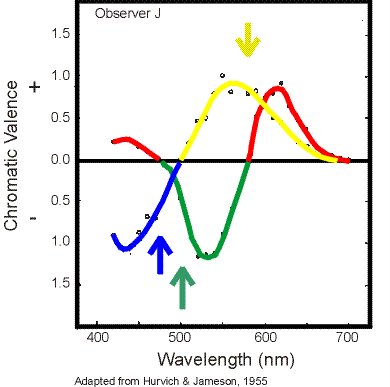
An account of how all hues can be realized using this opponent processing is explained beautifully at this site and I also include a graph from that site for illustration of how all hues (in the humanly visible spectrum) can be realized using these opponent process. That said, there still remains the issue of perception of non-spectrum colors like purple, olive green , brown etc., these have been partly addressed in my earlier post on this matter.

To sum up, the moving green dot illusion works because red and green are opponent processes. When pink (which may be conceived as low-saturation red) dots are present in the visual field, then for that portion of visual filed, Red Qualia is exaggerated and Green Qualia inhibited further down the visual pathways. Prolonged presence of Red stimuli ensures that there is no need to keep inhibiting 'green qualia' as habituation happens and as the Red signal is strong and continuous one so the need to inhibit Green does not arise. If one refers to the gated dipole opponent process theory of Grossberg, then it is apparent that due to the gating of the dipole, when the RED stimuli disappears from the on-channel then the 'off channel' (corresponding to Green qualia) would result in a sudden rebound and thus momentarily the Green qualia would be perceived. Here it is instructive to note that the signal is R minus G i.e Red is the presence of signal and green the absence (or below threshold or negative signal). Thus the green dot illusion would become more stronger if pure red is used and a similar illusion can be produced by moving yellow dot when blue dots are involved.

Sphere: Related Content

Monday, July 10, 2006

V1 and imagination

Small Grey Matters has a post related to an experimental finding that there is an activation in V1- the striate cortex- when the subjects make motor responses to an earlier presented visual stimuli (this is the delayed response situation as in the post/ experiment). Also, this activation is not present in higher visual cortical areas and thus is a result of bottom-up processes. One speculation as to the presence of this activation about the same time as the motor response is that when making the response one needs to 'bring back to memory' or imagine the earlier presented stimuli (or the no-stimuli screen) and that bringing such image back to mind is necessary for the subjects to decide whether the stimuli was present or not.

Thus, a particular mechanism for explaining this activation could be that it is related to imagining the earlier-presented stimuli and is distinguished from the actual visual experience by lack of activation in higher visual areas. The 'imaginative center' of the brain may send inhibitory signals to the higher visual cortical areas so that this appears as imagination and not as actual hallucinatory delayed visual stimuli.

Just speculation, but speculations that could be verified if supporting experiments are conducted by someone.

Sphere: Related Content

Friday, June 30, 2006

Color vision continued: What role do rods play in color vision, if any and how many dimensions/ variables we need.


There is a very descriptive and helpful book eye, brain and vision on Hravard's site and I was going through the chapter on color vision. It is posited there that color blindness occurs if one of the 3 cone pigments are not present and consequently one is not able to distinguish white light from a monochromatic light of certain wavelength. It is also posited that for color vision only 3 types of receptors are required (and are present in the form of 3 types of cones in the retina). Now here is some experimental work that I would like done for this experiment. What happens to someone who lacks the green pigment and who is exposed to light in the wavelength of light between the non-overlapping visual fields of blue cone and red cone. As per the arguments in the book, that should lead to total loss of color (and actual colorblindness as opposed to color-defectiveness for that range of colors) and thus ability to use only rods and thus get a black and white view of world for those wavelengths. Is that really so, as per color blind people with the green cone not present?

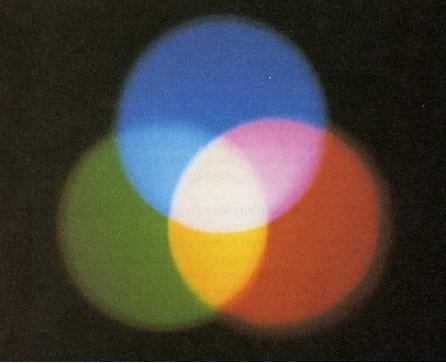
The other thought that passed while reading the article is that it uses projection of 3 types of monochromatic light with same intensities as the metaphor of choice while describing how the brain processes color. Unfortunately as we know, the blue color cone does not overlap with red color cones and this metaphor may not be right. Even, with this metaphor it strikes one as to how black is perceived, because the picture that is shown of 7 colors (including white) produced depends on a dim room in which the 3 lights are projected and the rods that would be useful in producing this black color are integral to the experimental setup of demonstrating the tri-color sufficiency of explaining the color vision. I , personally believe that rods do have a role in color perception and color perception may more involve the CMYK model than the RGB. This also brings the 'image formation' metaphor over the 'laser beam' model. Also, at the same time, due to Kline-bottle associations I may even venture forth and propose that in reality 6 types of colors/ color detecting devices may be required to fully apprehend the colors and we may still be in the process of evolving/ detecting such pigments. Maybe the rods themselves of nocturnal animals like wild cats may throw some light. Total armchair speculation!

Interestingly, the author of the above book concedes that Brown color is a bit difficult to explain, though purple can be easily explained or be intuitive. As per this article on color naming universals which references the article Berlin and Kay (1969) published under the title 'Basic Color Terms, their Universality and Evolution'. the brown appears in stage VI of a language evolution, where apparently as per my initial eight fold developmental model, a qualitatively different sort of leap needs to be taken. The original Harvard's book excerpt from "Eye, brain and vision" takes recourse to Herring theory of opponent processes, specifically that of red and yellow mixing to give orange and that when seen through black contrast giving appearance to brown. Thus for brown to be explained,, the 2 extreme edges of blue-yellow dimensions and red-green dimensions have to mix spatially at a point and then this has to be seen in contrast to another extreme of black-white dimension. Seems a complicated explanation and involves taking recourse to brains excitatory and inhibitory processes to provide explanation. I might revisit this later if some more suitable explanations in terms of some other inherent property of cooler like using both the hue, saturation, value and R,G,B model may explain brown. While HSV explains purple (in the sense of it being complement of green and actually lying in the region that sort of make ultra-violet and infra-red meet), it is surprising why it is not one of the words that are found while going from stage V to stage VI of language evolutions.

Endgame: Is CMYK actually CMYKW model, with white of paper acting as background essential for the CMYK to work in reproducing images?

Sphere: Related Content